
Written by Leon Chow
China–Australia Freight Forwarding Specialist | Guangzhou Allwin Logistic
Week 36 | 07 August–13 September 2026
How We Track This Lane: This weekly update is compiled by Allwin Logistics’ operations team from carrier advisories (ANL, CMA CGM, ONE, Maersk), port authority notices, Linerlytica congestion data, and our own real-time booking experience on the China–Australia trade lane. We cross-reference at least three independent sources before publishing any congestion or rate figure. Last verified: 5 September 2026.
Post-typhoon congestion at Shanghai and Ningbo continues to drive 5–10 day vessel waits, while Tropical Storm Krovanh adds new uncertainty in the East China Sea. September GRIs total up to USD 1,100/TEU, BMSB season is now active, and the pre–Golden Week shipping rush is building. Here is your complete Week 36 update on shipping trends from China to Australia.
Overall Market Status: 🟠 Elevated Disruption
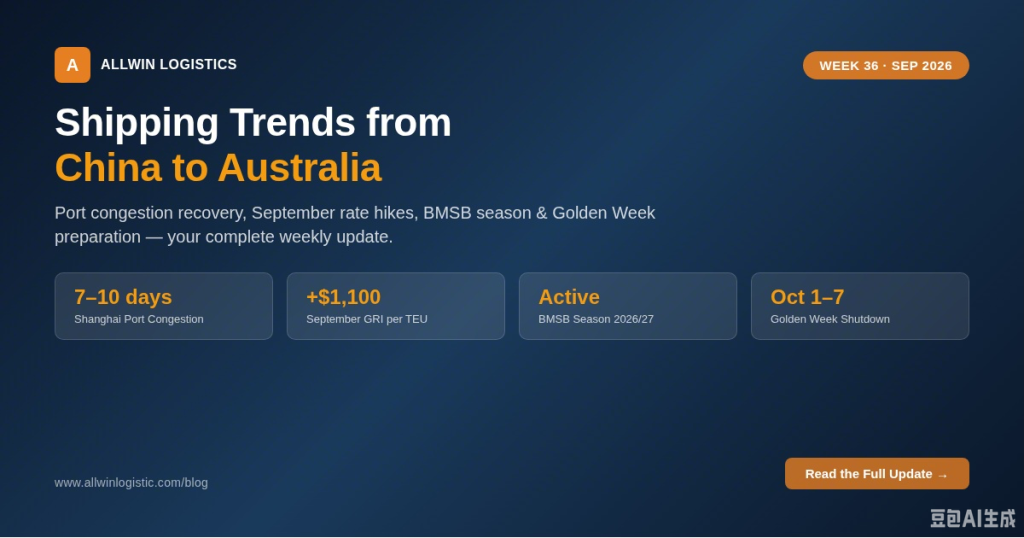
The shipping market from China to Australia remains under significant pressure as East China ports continue working through the backlog created by three consecutive typhoons (Bavi, Dolphin and Saudel) between July and August 2026. Shanghai and Ningbo remain the key congestion points, with vessel waiting times still elevated and carriers continuing to adjust schedules and port rotations.
Key stat: Linerlytica estimates that the combined congestion at Shanghai and Ningbo is holding up approximately 3.92 million TEU — equivalent to 11% of the global container shipping fleet. Global container congestion has now reached 4.3 million TEU waiting to berth worldwide, surpassing COVID-era peaks.
Adding to the complexity, Tropical Storm Krovanh (No. 24) has developed in the eastern East China Sea, bringing gale warnings to coastal waters. Meanwhile, the pre–Golden Week shipping rush is beginning to build, with China’s Mid-Autumn Festival (25–27 September) and National Day Golden Week (1–7 October) compressing the available shipping window to just 8–9 working days.
China Port Updates: Congestion Recovery Continues
Shanghai — Extended Vessel Queues
Terminals at the Port of Shanghai remain operational following Typhoon Saudel, but the accumulated backlog continues to drive significant delays. Prior to the typhoon, the number of vessels awaiting unloading had reached 139 — a new high in nearly two years.
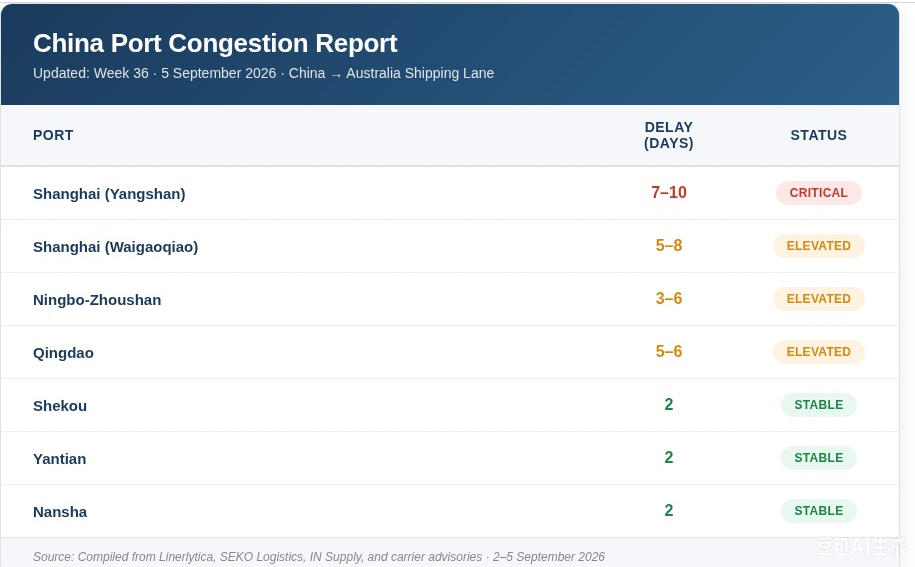
Current seven-day average vessel waiting times stand at approximately 5.21 days, with some terminals reporting waits of 7–10 days. Yangshan Terminal continues to experience the longest queues, with waits of up to 11 days for non-Gemini services.
Industry sources expect congestion recovery to take approximately three to four weeks, potentially overlapping with the traditional pre-National Day shipping rush in late September.
Ningbo — Critical Yard Density
Operations at Ningbo-Zhoushan have resumed, but yard occupancy remains critically high at 92–95%, with reefer plug utilisation at 94%. Current waiting times are reported at 3–6 days depending on carrier and service. The seven-day average stands at 3.45 days.
Approximately 77 container ships remain queued at Ningbo — levels not seen throughout 2025 or 2026. Hapag-Lloyd reported waits of up to five days for Gemini services and three to six days for other services.
South China — Relatively Stable
Ports in South China (Yantian, Shekou, Nansha) remain operational with significantly shorter waiting times (approximately 2 days). However, delays from East China continue to affect vessel rotations and equipment availability across the region.
Gate-in controls for ETB-7 remain in effect, with the container acceptance cap set at 120% of the maximum single-voyage load volume recorded for the route over the past three months.
Overall: Further vessel bunching, port omissions and schedule changes are expected while carriers work through the backlog. The pre–Golden Week cargo surge is expected to intensify congestion from mid-September.
Table: China Port Congestion Snapshot — Week 36 (as of 5 September 2026)
Australia Ports: Under Pressure from Import Volumes
Australian ports are currently operating, although Sydney and Melbourne remain under pressure from strong import volumes and off-schedule vessel arrivals caused by the East China congestion.
Sydney / Port Botany
The waiting time for berthing is approximately 3 days, and about 72% of shipments fail to arrive on schedule. CMA CGM’s KEA service (OLUF MAERSK 637N/632S) recently omitted Sydney due to technical issues and schedule recovery needs, announced 2 September 2026.
Melbourne
The waiting time for a berth is approximately 3 days. Skipped port calls remain a risk as carriers prioritise schedule recovery. The ANL GIPPSLAND 092N previously omitted Melbourne in late August.
Brisbane
Current port congestion appears relatively low compared with the situation in East China. However, landside pressure is building as import volumes increase ahead of the Australian peak retail season.
Vessel Schedule & Capacity: Omissions and Blank Sailings
Schedule reliability remains the main concern for shipping from China to Australia this week. The post-typhoon backlog continues to create significant vessel bunching and schedule disruption across East China.
Several carriers have responded with temporary port omissions, revised rotations and schedule recovery measures. Carriers cancelled 10 sailings in each of the past two weeks, and further blank sailings are expected in the lead-up to Golden Week (Weeks 39–43).
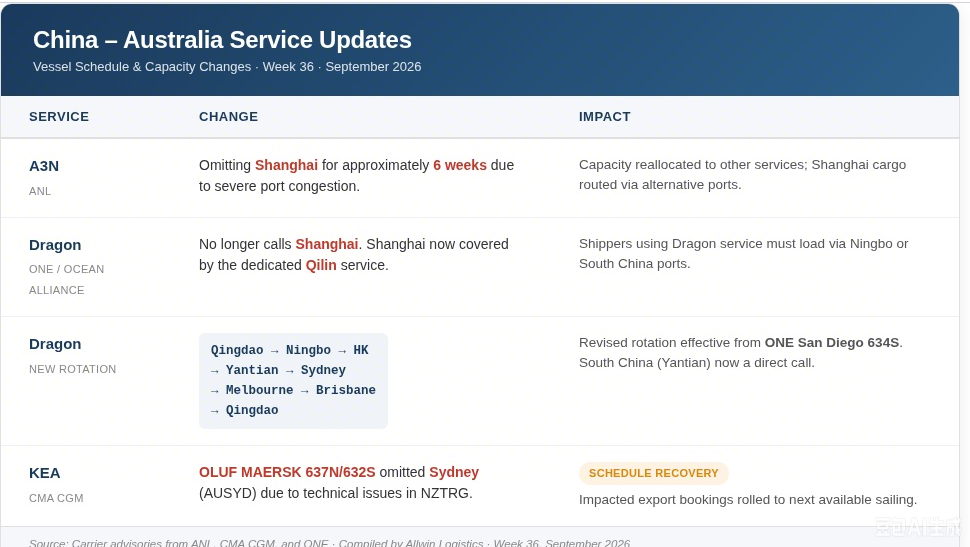
Expected impact: Original ETD/ETA schedules may continue to be delayed as carriers work through accumulated delays and vessel bunching. The pre–Golden Week rush is expected to further tighten space availability from mid-September. For fast shipping from China to Australia, consider routing via South China ports where waiting times are currently shorter.
Freight Rate Trend: September GRIs Take Effect
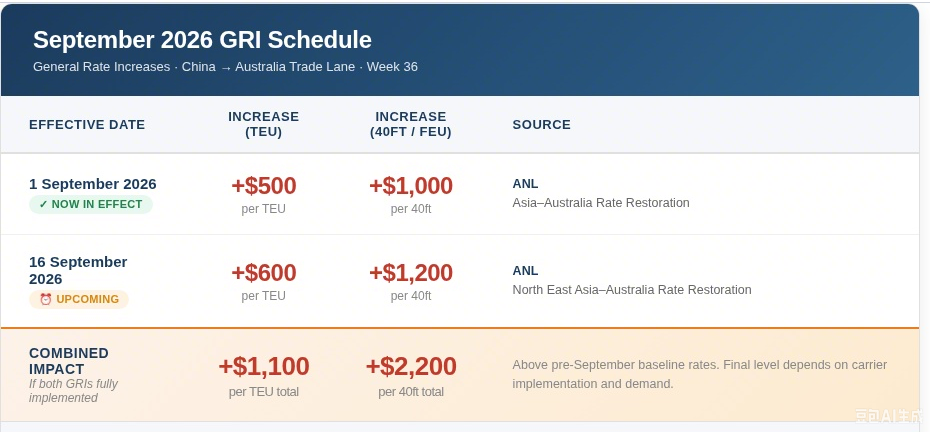
Freight rates for shipping to Australia continue trending upward in September. After the rate increases seen during August, carriers have announced further General Rate Increases (GRIs) for the China–Australia trade:
Table: September 2026 GRI Schedule — China to Australia
If both increases are fully implemented, this could mean approximately USD 1,100/TEU, or USD 2,200 per 40′ container, above pre-September levels.
The combination of port congestion, vessel bunching, port omissions, reduced effective capacity and the pre–Golden Week demand surge is creating conditions that support higher freight rates. However, the final level of each increase will depend on demand and how successfully carriers implement the announced GRIs.
Our recommendation: For cargo planned to ship in September and early October (before Golden Week), we strongly recommend requesting and confirming current all-in rates at the time of booking, rather than relying on older quotations. Where possible, securing space and rates earlier may help reduce exposure to further increases and space shortages during the pre-holiday peak. For stable shipping from China to Australia, early booking is the most effective strategy in the current market.
Weather Alert: Tropical Storm Krovanh Adds Uncertainty
While Typhoon Saudel has now weakened and been officially removed from active tracking by the China Meteorological Administration on 4 September 2026, Tropical Storm Krovanh (No. 24) has developed in the eastern East China Sea.
Krovanh is not currently forecast to make direct landfall in mainland China. However, its slow and meandering movement near Japan’s Ryukyu Islands is creating difficult conditions for vessels operating in the region. Gale warnings (Force 6–9) have been issued for the coasts of Jiangsu, Shanghai, Zhejiang and northern Fujian.
In Zhoushan, 56 water engineering projects have been suspended and 39 maritime routes have been affected. A storm surge warning has also been issued for parts of China’s northern coast, with water levels expected to rise by 40–60 cm above normal.
Critical context: This marks the fourth consecutive tropical system affecting East China shipping since July, following Typhoons Bavi, Dolphin and Saudel. The cumulative impact has been unprecedented vessel bunching and schedule disruption.
The main risk from Krovanh is not a direct port shutdown, but further disruption to vessel schedules and navigation in the East China Sea at a time when carriers are already struggling to clear the Saudel backlog. At this stage, the situation in East China is a combination of:
- Ongoing backlog recovery from Typhoon Saudel
- New operational uncertainty from Tropical Storm Krovanh
- Building pre–Golden Week shipping demand
Golden Week 2026: Pre-Holiday Shipping Rush Begins
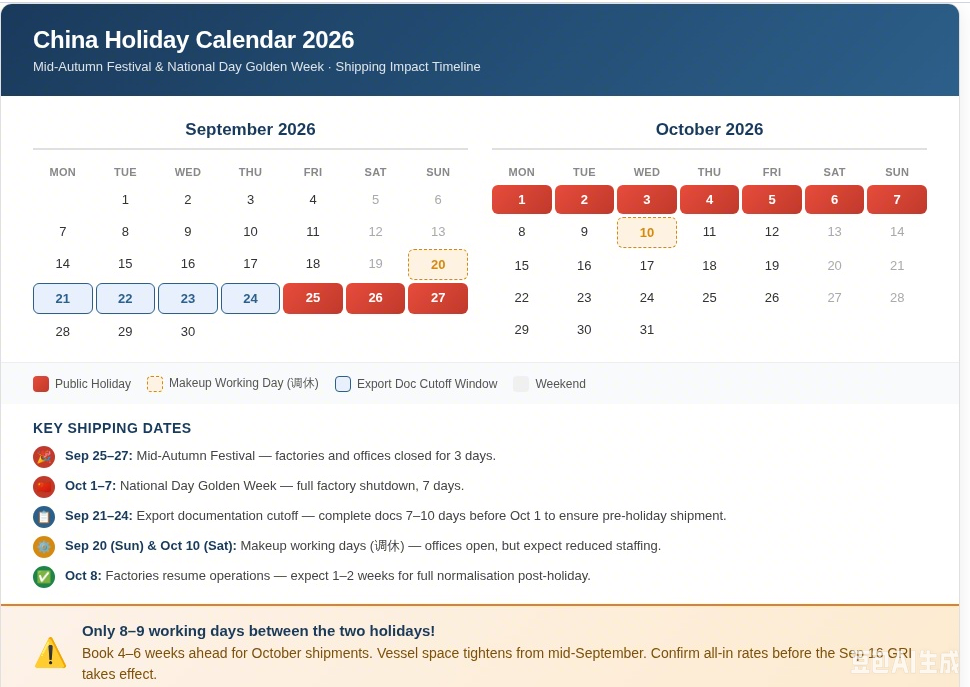
The pre–Golden Week shipping rush is now building and will significantly impact shipping from China to Australia throughout September. In 2026, the holiday calendar creates an unusually tight window:
- Mid-Autumn Festival: 25–27 September 2026
- National Day Golden Week: 1–7 October 2026
- Working days between holidays: Only 8–9 working days (28 September – 30 September, then resumes 8 October)
This compressed timeline means exporters are rushing to move cargo before factory closures, creating a surge in both ocean and air freight volumes. Key impacts:
- Vessel space is expected to become increasingly tight from mid-September, with 40HQ container demand peaking around Week 37–38.
- Carriers have announced blank sailings for Weeks 39–43, with Ocean Alliance (~78,000 TEU), MSC (~62,000 TEU) and others reducing capacity.
- Export documentation must be completed 7–10 days before 1 October to ensure cargo can ship before the holiday cutoff.
- Equipment and container availability will tighten, particularly at congested East China ports.
- Post-Golden Week backlogs are expected, with full normalisation potentially taking 1–2 weeks after factories reopen on 8 October.
Recommended booking lead time: 4–6 weeks ahead for October shipments (vs. the standard 3 weeks). Late bookings (less than 3 weeks ahead) may face rolled sailings or spot rates up to 50% above average.
Our Recommendations for Shipping from China to Australia
Based on the current shipping trends from China to Australia, we recommend the following actions for shipments with firm delivery deadlines:
- Book earlier — vessel availability may remain tight while carriers recover their schedules, and the pre–Golden Week rush will further reduce available space. We recommend booking 4–6 weeks ahead for October shipments.
- Allow additional buffer time — do not rely solely on the original carrier ETA. Current congestion can add 5–10 days to transit times.
- Confirm the latest vessel schedule before dispatch, particularly for Shanghai and Ningbo cargo.
- Check BMSB requirements for all cargo shipping to Australia from 1 September onward. Ensure treatment certificates are in order before departure.
- Consider alternative services or routings if your cargo is urgent and the delivery deadline is critical. South China ports (Yantian, Shekou) currently have shorter waiting times and may offer fast shipping from China to Australia.
- Lock in rates early where possible to avoid exposure to further GRIs and peak-season surcharges.
Frequently Asked Questions (FAQ)
How long are vessel waiting times at Shanghai right now?
Current waiting times at Shanghai are approximately 5–10 days depending on the terminal and carrier service. Yangshan Terminal reports the longest queues (up to 11 days for non-Gemini services), while the seven-day port-wide average stands at approximately 5.21 days. Congestion recovery is expected to take three to four weeks.
What is the total impact of the September rate increases?
Carriers have announced GRIs of USD 500/TEU effective 1 September (now in effect) and a further USD 600/TEU effective 16 September — totalling approximately USD 1,100/TEU or USD 2,200 per 40′ container above pre-September levels. The actual impact depends on how successfully carriers implement the increases.
How will Golden Week affect my shipments?
China’s Golden Week (1–7 October) and Mid-Autumn Festival (25–27 September) create a compressed shipping window of only 8–9 working days. Vessel space will tighten from mid-September, carriers have announced blank sailings, and export docs must be ready 7–10 days before 1 October. Book 4–6 weeks ahead for October shipments.
Is shipping from China to Australia still reliable?
While the current market faces elevated disruption due to port congestion, weather events and pre-holiday demand, shipping from China to Australia remains operational. The key is proactive planning: book early, allow buffer time, confirm schedules before dispatch, and work with an experienced freight forwarder who can navigate carrier changes and alternative routings. South China ports currently offer more stable options than Shanghai/Ningbo.
What is the current status of Tropical Storm Krovanh?
Tropical Storm Krovanh (No. 24) is currently in the eastern East China Sea and is not forecast to make direct landfall in mainland China. However, it has triggered gale warnings (Force 6–9) along the coasts of Jiangsu, Shanghai, Zhejiang and northern Fujian, and is causing disruption to maritime operations. The main risk is additional schedule disruption, not port closures.
About This Update
This weekly update on shipping trends from China to Australia is compiled by Leon Chow, General Manager of Guangzhou Allwin Logistic Co., Ltd. With nearly 20 years of experience in the China–Australia and China–New Zealand freight forwarding industry, Leon oversees daily operations, carrier relationships and client logistics strategy. Allwin Logistics operates its own subsidiary in Australia (Hai Son Shipping and Transport Pty Ltd), providing on-the-ground warehousing, customs clearance and last-mile delivery services.
Our methodology: Each weekly update draws from carrier advisories (ANL, CMA CGM, ONE, Maersk, Hapag-Lloyd), port authority notices, Linerlytica congestion analytics, DAFF biosecurity updates, and our own real-time booking data. We cross-reference at least three independent sources before publishing any congestion or rate figure. This update was last verified on 5 September 2026.
Disclaimer: Shipping market conditions change rapidly. The information in this update reflects our best assessment as of the date above and should be used as a general guide only. For specific bookings, please contact our team for the latest vessel schedules and rate confirmations.
Need Help with Your China–Australia Shipments?
If you have urgent cargo or a fixed delivery deadline, contact Allwin Logistics today. We can review the latest sailing options, compare routings, and recommend the most reliable solution for your shipping from China to Australia.