
Shanghai & Ningbo port congestion reaches 6–11 day waits as Typhoon Saudel cleanup begins. September GRIs total ~$1,000/TEU. BMSB season starts 1 Sep. Latest update inside.
📌 Overall Market Status: 🟠 Elevated Disruption
The China–Australia shipping market remains under significant pressure following several consecutive typhoons and ongoing vessel bunching in East China. Shanghai and Ningbo remain the key congestion points, with vessel waiting times still elevated and carriers continuing to adjust schedules and port rotations.
Key stat: Global container congestion has now reached 4.3 million TEU waiting to berth worldwide—surpassing COVID-era peaks.
🇨🇳 China Port Updates
Shanghai – Critical Congestion
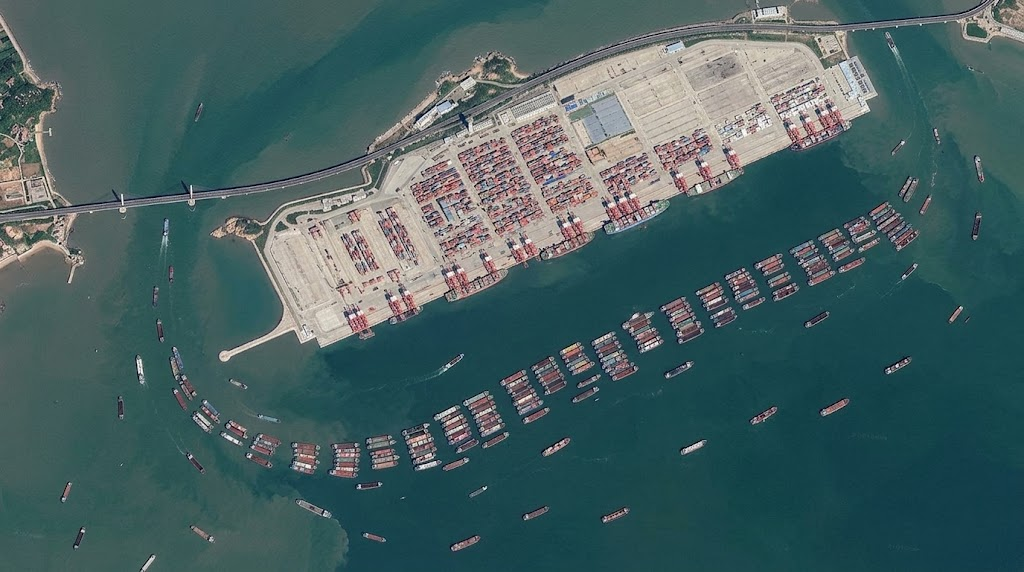
Operations resumed following Typhoon Saudel (heavy container handling restarted at 12:00 on 28 August, empty container handling at 14:00). However, prior to the typhoon, the number of vessels awaiting unloading had reached 139—a new high in nearly two years.
Current vessel waiting times at Shanghai are approximately 6–11 days at some facilities, with Yangshan Terminal reporting waits of up to 12 days.
Ningbo – Elevated Congestion
Operations have resumed following Typhoon Saudel, but accumulated vessel and cargo backlogs continue to affect schedule reliability. Approximately 77 container ships remain queued at Ningbo—levels not seen throughout 2025 or 2026. Current waiting times are reported at 3–5 days.
Industry sources expect congestion recovery to take approximately three to four weeks, potentially overlapping with the traditional pre-National Day shipping rush in late September.
South China – Monitor Closely
South China – Monitor Closely
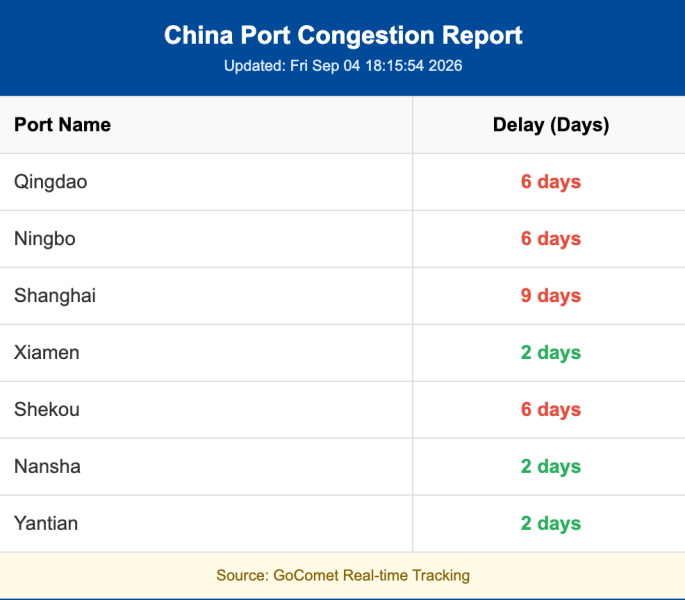
Ports remain operational, but delays from East China may continue to affect vessel rotations and equipment availability. Gate-in controls for ETB-7 remain in effect, with the container acceptance cap set at 120% of the maximum single-voyage load volume recorded for the route over the past three months.
Overall: Further vessel bunching, port omissions and schedule changes are expected while carriers work through the backlog.
🇦🇺 Australia Ports – Generally Operational
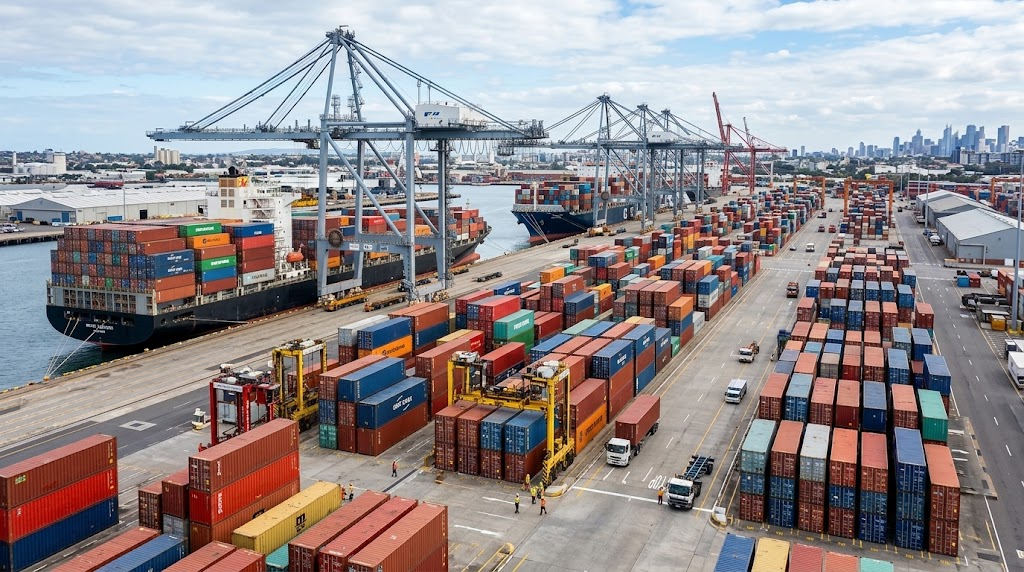
Australian ports are currently operating, although Sydney and Melbourne remain under pressure from strong import volumes and off-schedule vessel arrivals.
- Sydney / Port Botany: Berthing waiting time is approximately 3 days; about 72% of shipments fail to arrive on schedule.
- Melbourne: Berthing waiting time is approximately 3 days; recent skipped port call recorded (ANL GIPPSLAND 092N omitted Melbourne).
- Brisbane: Current port congestion appears relatively low compared with East China.
⏳ Vessel Schedule & Capacity
Schedule reliability remains the main concern this week. The recent typhoons have created significant vessel bunching and schedule disruption across East China. Several carriers have responded with temporary port omissions, revised rotations and schedule recovery measures.
Service updates:
| Service | Change | Impact |
| A3N | Omitting Shanghai for ~6 weeks | Capacity reallocated to other services |
| Dragon | No longer calls Shanghai | Now covered by dedicated Qilin service |
| Dragon new rotation | Qingdao → Ningbo → Hong Kong → Yantian → Sydney → Melbourne → Brisbane → Qingdao | Revised effective from ONE San Diego 634S |
Expected impact: Original ETD/ETA schedules may continue to be delayed as carriers work through accumulated delays and vessel bunching.
📈 Freight Rate Trend – Rates Trending Upward
After the rate increases seen during August, carriers have announced further General Rate Increases (GRIs) for the China–Australia trade:
| Effective Date | Increase Amount | Source |
| 1 September | USD 500/TEU & USD 1,000/FEU | ANL Asia–Australia Rate Restoration |
| 16 September | USD 600/TEU & USD 1,200/FEU | ANL North East Asia–Australia |
Combined impact: If both increases are fully implemented, this could mean approximately USD 1,100/TEU, or USD 2,200 per 40′ container, above current levels.
The combination of port congestion, vessel bunching, port omissions and reduced effective capacity is creating conditions that support higher freight rates. However, the final level of each increase will depend on demand and how successfully carriers implement the announced GRIs.
Our recommendation: For cargo planned to ship in September, we recommend requesting and confirming current all-in rates at the time of booking, rather than relying on older quotations. Where possible, securing space and rates earlier may help reduce exposure to further increases.
🌪️ Weather Alert – Typhoon Saudel: Situation Improving
Typhoon Saudel made landfall in southern Zhejiang on 28 August and has since weakened. Shanghai and Ningbo terminals have reopened, with container yards, warehouses and other operations progressively resuming.
However, the immediate weather disruption has now shifted into a schedule-recovery problem. Vessels delayed by the typhoon are arriving in bunches, contributing to continued congestion and longer waiting times.
Critical context: This marks the third typhoon closure for Shanghai and Ningbo in as many months, following Typhoons Bavi and Dolphin.
At this stage, the main risk is no longer a direct typhoon shutdown, but the knock-on effect of the accumulated backlog.
🐛 BMSB Season 2026/27 – Effective 1 September
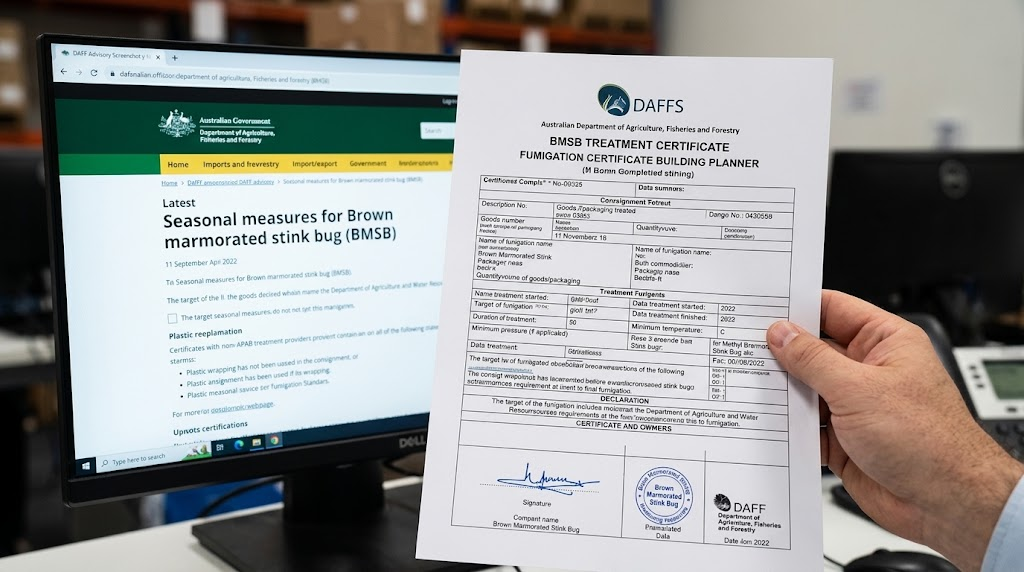
Australia’s 2026/27 Brown Marmorated Stink Bug (BMSB) season begins 1 September 2026.
Key requirements:
- Seasonal measures apply to goods manufactured in or shipped from designated target risk countries between 1 September 2026 and 30 April 2027 (based on shipped-on-board date)
- Target high-risk goods require mandatory BMSB treatment by a DAFF-approved provider
- Target risk goods may be subject to random inspection
- Break bulk cargo (including flat racks and open-top containers) must be treated offshore before arrival—onshore treatment is not permitted
- China continues to be classified as an emerging risk country, resulting in increased random inspections
Target high-risk categories include: Wood products, ceramic products, glass and glassware, iron and steel, aluminium and other base metals, machinery and electrical equipment, vehicles and parts, ships and other vessels.
Our recommendation: Importers should ensure affected cargo is correctly treated and documented under the new seasonal requirements to avoid potential customs or clearance delays. Early confirmation of applicable requirements is strongly recommended.
💡 What We Recommend This Week
For shipments with firm delivery deadlines:
- Book earlier — vessel availability may remain tight while carriers recover their schedules. Some forwarders recommend booking 3–4 weeks ahead.
- Allow additional buffer time — do not rely solely on the original carrier ETA.
- Confirm the latest vessel schedule before dispatch, particularly for Shanghai and Ningbo cargo.
- Check BMSB requirements for cargo shipping to Australia from 1 September onward.
- Consider alternative services or routings if your cargo is urgent and the delivery deadline is critical.
- Lock in rates early where possible to avoid exposure to further GRIs.
❓ Frequently Asked Questions (FAQ)
Q: How long are vessel waiting times at Shanghai right now?
A: Current waiting times at Shanghai are approximately 6–11 days, with some terminals reporting up to 12 days.
Q: What is the total impact of the September rate increases?
A: Carriers have announced GRIs of USD 500/TEU effective 1 September and a further USD 600/TEU effective 16 September—totalling approximately USD 1,100/TEU or USD 2,200 per 40′ container.
Q: When does the BMSB season start and what do I need to do?
A: The BMSB season runs from 1 September 2026 to 30 April 2027. Affected cargo must be treated by a DAFF-approved provider. China remains an emerging risk country with increased random inspections.
Q: How long will the congestion last?
A: Industry sources expect congestion recovery to take approximately three to four weeks, potentially overlapping with the pre-National Day shipping rush.
📢 Our Professional Recommendation
The situation in East China is gradually moving from weather disruption to schedule recovery, but the accumulated backlog is likely to continue affecting vessel schedules in the coming weeks. With port congestion, vessel bunching, multiple GRIs and the start of BMSB season all converging in September, proactive planning is essential.
For September shipments, we recommend planning earlier, maintaining sufficient delivery buffer, checking the latest vessel schedule before cargo is dispatched, and confirming BMSB compliance requirements.
We will continue monitoring the China–Australia trade lane and keep you informed of any material changes that may affect your shipments.
If you have urgent cargo or a fixed delivery deadline, please contact us. We can review the latest sailing options and recommend the most reliable solution.