
Air Freight Market Update Before Golden Week 2026 – Shipping Trends From China To Australia – Week 39 Update
Written by Leon Chow
China–Australia Freight Forwarding Specialist | Guangzhou Allwin Logistic
China to Australia Freight Market Overview
Week 39 | 28 September – 4 October 2026
Overall Market Status: 🟠 Elevated Disruption
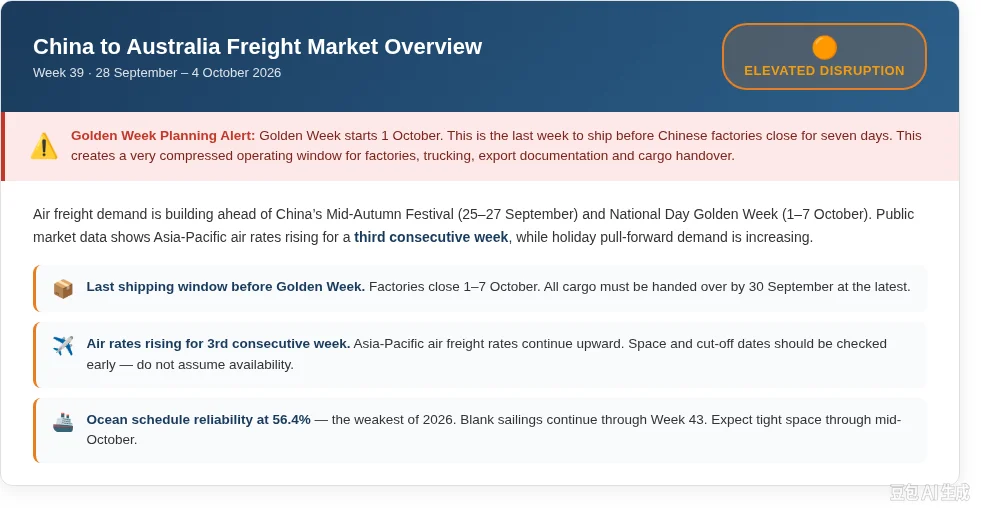
Golden Week starts 1 October. This is the last week to ship before Chinese factories close for seven days.
Golden Week Planning Alert
This creates a very compressed operating window for factories, trucking, export documentation and cargo handover.
Air freight demand is building ahead of China’s Mid-Autumn Festival (25–27 September) and National Day Golden Week (1–7 October). Public market data shows Asia-Pacific air rates rising for a third consecutive week, while holiday pull-forward demand is increasing. For China–Australia cargo, space and cut-off dates should be checked early rather than assumed to remain available.
Chinese factories, trucking service, shipping agents, shipping lines and airlines close for seven days. Air freight space from China to Australia is already tight. This air freight market update covers what shippers need to know before the holiday, including current rates, booking lead times, and what to expect after factories, trucking service, shipping agents, shipping lines and airlines reopen.
We handle hundreds of air freight shipments from China to Australia every month. Our team operates from Guangzhou and maintains a local warehouse and delivery network in Australia with our Australian team. This update draws on our live booking data, carrier announcements, and industry reports.
Current Air Freight Market Update Conditions
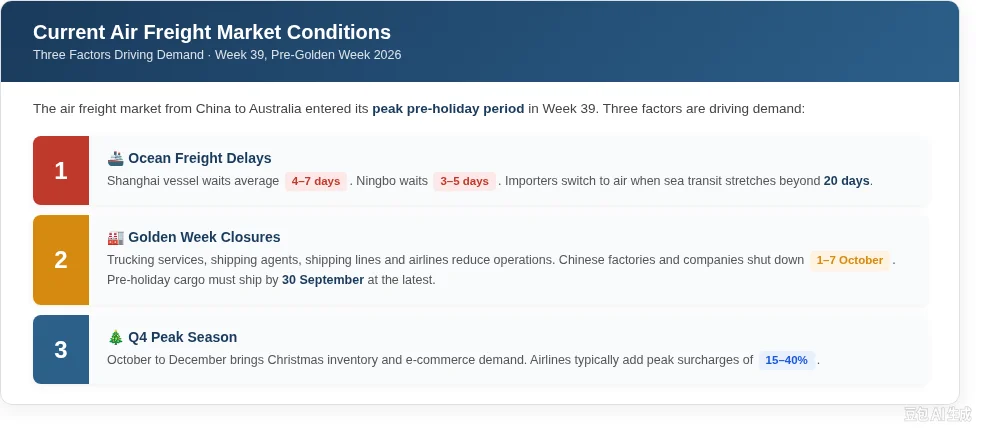
The air freight market from China to Australia entered its peak pre-holiday period in Week 39. Three factors are driving demand:
- Ocean freight delays. Shanghai vessel waits average 4-7 days. Ningbo waits 3-5 days. Importers switch to air when sea transit stretches beyond 20 days. (Source: Kuehne+Nagel Port Congestion Index, Week 39, September 2026.)
- Golden Week trucking service, shipping agents, shipping lines and airlines closure. Chinese factories and companies shut down from 1 to 7 October. Pre-holiday cargo must ship by 30 September at the latest.
(Source: Official 2026 China National Day holiday schedule, State Council of China.) - Q4 peak season. October to December brings Christmas inventory and e-commerce demand. Airlines typically add peak surcharges of 15-40%.
(Source: TAC Index air freight rate data, Q4 2025 peak season analysis; industry forwarder consensus.)
At Guangzhou Baiyun Airport, our latest booking data shows China Southern Airline cargo waiting approximately one week for uplift. Hainan Airline requires at least seven days of advance planning. Other Chinese gateway airports report backlogs of 1-2 days.
The most important air freight market update this week is the holiday-driven pull-forward of cargo.
Flexport reported on 24 September that Asia-Pacific air rates had risen for a third consecutive week. In North China, general cargo demand was increasing as shippers moved freight ahead of Golden Week. New charter capacity was absorbing part of the pressure, so rates were holding steady week on week in that market.
South China was more balanced. Flexport reported ample supply on the markets it tracks, with only slight rate increases. This shows why importers should not treat “air freight space fully booked” as a universal China-wide condition. Space can differ sharply by airport, destination, airline, cargo type and departure date.
For China–Australia shipments, the practical question is not simply whether an airline has capacity. It is whether the required flight can accept the shipment at the right weight, dimensions, cargo type and cut-off time.
Our planning rule: if the cargo has a firm delivery deadline before or soon after Golden Week, check space before the cargo is ready. Do not wait until the last working day.
Air Freight Rates from China to Australia
Rates have climbed steadily since late August. Rates vary by weight break, origin airport, and carrier. Always confirm a live quote at booking. Fuel surcharges and peak season fees may apply on top of base rates.
Freightos also notes that China–Australia air rates change regularly and that shipment size and season affect transit time and cost.
The latest Flexport update gives a useful market signal rather than a China–Australia quote. Asia-Pacific air rates were rising for a third consecutive week as holiday cargo was pulled forward.
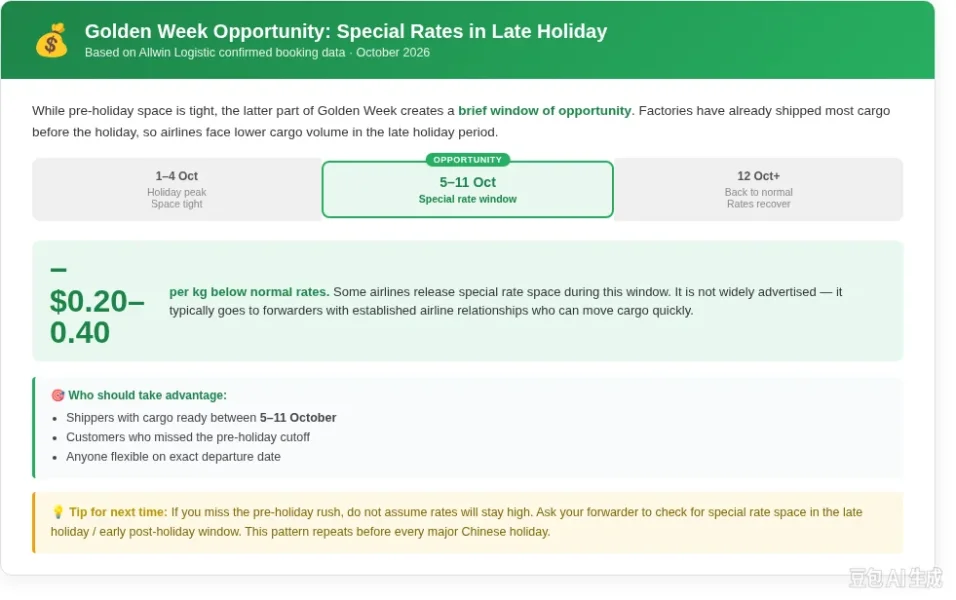
Golden Week Opportunity: Special Rates in Late Holiday
While pre-holiday space is tight, the latter part of Golden Week creates a brief window of opportunity.
Based on our confirmed bookings, factories have already shipped most cargo before the holiday. This means airlines face lower cargo volume from approximately 5 October through 11 October — the last two days of the holiday plus the first three working days after.
During this window, some airlines release special rate space at roughly USD 0.20–0.40/kg below normal rates. This is not widely advertised. It typically goes to forwarders with established airline relationships who can move cargo quickly.
Who should take advantage: shippers with cargo ready between 5–11 October, customers who missed the pre-holiday cutoff, and anyone flexible on exact departure date.
Tip for next time: If you miss the pre-holiday rush, do not assume rates will stay high. Ask your forwarder to check for special rate space in the late holiday / early post-holiday window. This pattern repeats before every major Chinese holiday.
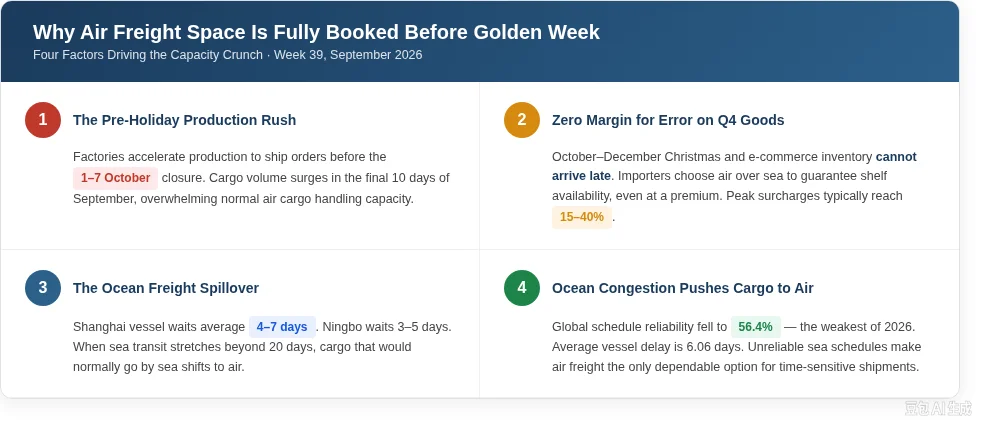
Why Air Freight Space Is Fully Booked Before Golden Week
The Pre-Holiday Production Rush
Throughout September, the factory has been operating at full capacity to meet production targets before the workers go on holiday. Once this massive batch of goods is completed, a high-pressure race against the clock will ensue to load them onto aircraft before the plant shuts down.
Zero Margin for Error on Q4 Goods
The “Golden Week” holiday falls just before the most critical period of the year for the global retail industry. For time-sensitive shipments—such as Halloween merchandise, electronics destined for Black Friday sales, or winter apparel—importers cannot afford a delay of up to two weeks, as this would cause them to miss the peak sales season. Consequently, air freight becomes the essential choice for ensuring timely delivery.
The Ocean Freight Spillover
As the holiday season approaches, ocean carriers frequently implement “blank sailings” (canceling scheduled voyages) to adjust capacity for the post-holiday period. When shipments face delays or port congestion occurs, shippers with urgent cargo often switch their highest-priority goods to air freight as a contingency measure, causing an immediate shortage of available air cargo capacity.
Ocean congestion pushes cargo to air
Global schedule reliability fell to 56.4% in September, the weakest level of 2026. Average vessel delay reached 6.06 days. When sea freight becomes unreliable, importers pay a premium for air to protect stock levels. (Source: Sea-Intelligence Global Liner Performance Report, September 2026.)
Sea Freight Rates Also Rising
Ocean freight cost to Australia climbed for three rounds of rate restoration in September. For ocean freight, the latest Shanghai–Sydney SCFI benchmark reported for Week 38 was USD 5,510/FEU, up 4% from Week 37. Earlier September increases and additional carrier surcharges have kept the market above its earlier 2026 levels.
ANL announced a further rate restoration effective 1 October 2026: +USD 500 per 20-foot container and +USD 1,000 per 40-foot container for North East Asia to Australia shipments. (Source: ANL official customer notice, “North East Asia to Australia Rate Restoration,” published 2 September 2026, anl.com.au.)
The blank sailing rate on Australia trades rose from 6% to 9% in September. Carriers plan to withhold capacity through Golden Week (Weeks 39-43). This keeps ocean rates firm and makes air freight a competitive option for urgent cargo. (Source: Linerlytica Market Pulse, September 2026; Sea-Intelligence schedule reliability data.)
China Port Congestion Still Affects Air Freight Planning
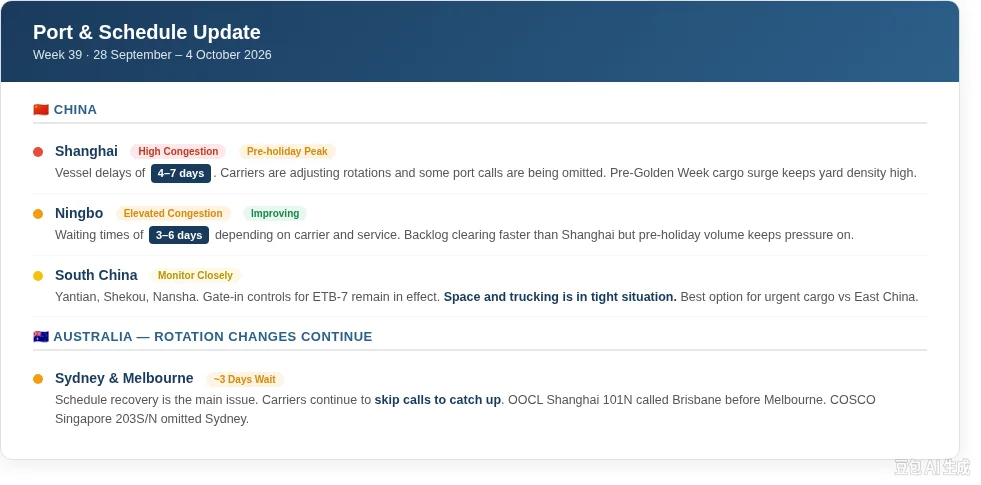
- Shanghai: Average vessel wait ~4.5 days. Worst terminals see 5-7 days. Pre-holiday cargo surge keeps yard density high.
- Ningbo: Average wait ~3.5 days. Meishan terminal ~5 days. Backlog clears faster than Shanghai.
- South China (Yantian, Shekou, Nansha): Stable at ~1-2 days. Best routing for urgent cargo.
- Sydney and Melbourne: ~2-3 days. Carriers continue rotation changes. OOCL Shanghai 101N called Brisbane before Melbourne due to berth congestion.
Source: Kuehne+Nagel Port Congestion Index, Week 39, September 2026; ANL service update notices, anl.com.au, September 2026.
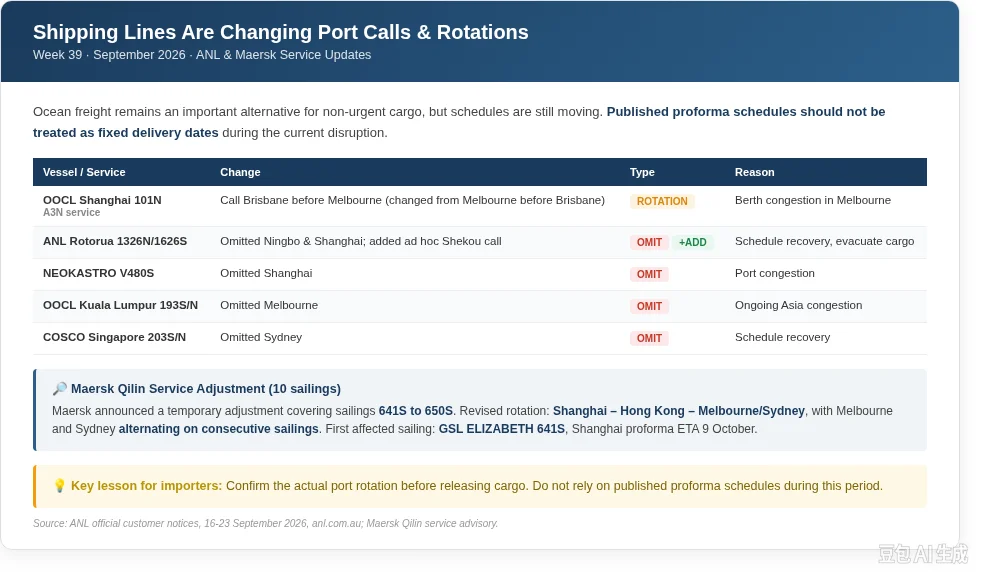
Shipping Lines Are Changing Port Calls and Rotations
Ocean freight remains an important alternative for non-urgent cargo, but schedules are still moving.
ANL announced on 21 September that OOCL Shanghai 101N on the A3N service would change its Australian rotation. The vessel will call Brisbane before Melbourne because of berth congestion in Melbourne.
ANL also reported recent omissions and recovery measures:
- ANL Rotorua 1326N/1626S omitted Ningbo and Shanghai and added an ad hoc Shekou call to help evacuate cargo.
- NEOKASTRO V480S omitted Shanghai.
- OOCL Kuala Lumpur 193S/N omitted Melbourne.
- COSCO Singapore 203S/N omitted Sydney.
These changes show why published proforma schedules should not be treated as fixed delivery dates during the current disruption.
Maersk has also announced a temporary Qilin service adjustment covering 10 sailings, from 641S to 650S. The revised rotation uses Shanghai–Hong Kong–Melbourne/Sydney, with Melbourne and Sydney alternating on consecutive sailings. The first affected sailing is GSL ELIZABETH 641S, with a Shanghai proforma ETA of 9 October.
For Australian importers, the key lesson is simple: confirm the actual port rotation before releasing cargo.
What Shippers Should Do: Allwin’s practical recommendations
Urgent air freight:
- Check space before cargo is ready.
- Confirm chargeable weight and dimensions early.
- Ask for at least one alternative flight or airport.
- Confirm the rate validity period.
- Keep supplier and forwarder communication active during the holiday window.
Ocean freight:
- Confirm the latest vessel rotation.
- Check for Shanghai or Ningbo omissions.
- Do not plan from proforma ETA alone.
- Confirm equipment availability early.
- Reconfirm October rates and surcharges before booking.
Both modes:
- Check supplier holiday schedules.
- Prepare export documents before the final pre-holiday rush.
- Build buffer into the delivery plan.
- Review Australian biosecurity requirements, including BMSB rules where applicable.
Frequently Asked Questions
Is air freight space fully booked before Golden Week?
Not across the entire China–Australia market. Public data shows stronger holiday demand, but capacity differs by airport, airline, destination and cargo type. A specific flight can be full while another option still has space.
How far in advance should I book air freight before Golden Week?
Book at least one week in advance for direct flights. For indirect service, allow 3-5 days. During the peak pre-holiday week, some routes require 10-14 days of advance booking.
Will air freight rates go down after Golden Week?
Rates may ease slightly in mid-October as capacity returns. However, Q4 peak season demand will likely keep rates above summer levels through December.
Can I ship during Golden Week?
Air freight operations continue during the holiday period, but trucking companies, customs brokers, shipping agents, shipping lines, and airlines will be closed. Therefore, all documentation and operational procedures for shipments departing during the holiday must be finalized beforehand.
Allwin Logistic rúhé zhù nín cóngróng yìngduì “huángjīn zhōu”? Allwin Logistic ràng nín nénggòu quánchéng zhǎngkòng huòyùn zhuàngtài——zài yánwù hé shuǎi guì xiànxiàng pín fā de shíqí, zhè yīdiǎn yóuwéi zhòngyào. Nín kě zhíjiē yǔ wǒmen 1 duì 1 jíshí gōutōng, huòqǔ yùn jià bàojià, duìbǐ zhōngguó zhì àodàlìyǎ de yùnshū lùxiàn, xuǎnzé fúhé nín shíjiān ānpái de yùnshū fāngshì, bìng quánchéng zhuīzōng huòwù cóng tíhuò dào sòng dá de dòngtài, wúxū fēnbié duìjiē huòyùn, bàoguān hé bǎoxiǎn děng bùtóng fúwù fāng. Ruò yīn gōngyìng shāng fàngjià ānpái dǎozhì huòwù bèi tuǒ shíjiān tuīchí,Allwin Logistic tuánduì kě xiézhù nín duìbǐ chuán qí yǔ jié guān shíjiān, zhù nín zhǎodào shì pèi xīn bèi tuǒ shíjiān de yùnshū fāng’àn. Liǎojiě Allwin Logistic de yùnzuò fāngshì, bìng huòqǔ nín xià yī pī cóng zhōngguó fāchū de huòwù de yùn jià bàojià.
How does Allwin Logistic help you plan ahead the “Golden Week” with ease?
Allwin Logistic gives you full visibility and control over your shipment status—a crucial advantage during periods frequently marked by delays and cargo roll-overs. You benefit from direct, one-on-one communication to obtain quotes, compare shipping routes from China to Australia, and select the transport method that best fits your schedule. You can track your shipment’s progress from pickup to final delivery without the hassle of coordinating separately with multiple service providers for freight, customs clearance, and insurance. If supplier holiday schedules delay your cargo readiness, the Allwin Logistic team can help you compare sailing schedules and cargo cut-off times to find a shipping solution that aligns with your updated timeline.
Learn more about how Allwin Logistic operates and get a quote for your next shipment from China. info@allwinlogistic.com
About This Update
This weekly air freight market update is written by Leon Chow, Guangzhou Allwin Logistic.A freight forwarder with nearly 20 years of experience specialising in China-Australia and China-New Zealand trade. Allwin Logistic operates a local warehouse and delivery network in Australia.
Our China–Australia updates combine public carrier advisories, port operational data, government notices, market reports and Allwin’s own booking experience. Public rate figures are treated as market benchmarks, not guaranteed customer quotations.
For Week 39, key sources include Maersk, ANL, Kuehne+Nagel, Flexport, DAFF, Qantas Freight, Freightos and the Chinese government holiday schedule.
Last verified: 27 September 2026.
Shipping conditions can change quickly. Always confirm the latest flight space, vessel schedule, rate and cargo requirements before booking.
Source Notes — Week 39 Verification
Kuehne+Nagel, Port operational updates 16–22 Sep 2026: https://mykn.kuehne-nagel.com/news/article/port-operational-updates-from-22-09-2026
ANL, latest service updates: https://www.anl.com.au/latest-news?id=1891
Maersk, Qilin temporary operational adjustment: https://www.maersk.com.cn/news/articles/2026/09/21/temporary-operational-adjustment-qilin-service
Maersk, East Asia typhoon update: https://www.maersk.com.cn/news/articles/2026/09/18/east-asia-typhoon-season-update-2
Flexport, Global Logistics Update 24 Sep 2026: https://test-www.flexport.com/global-logistics-update/september-24-2026-glu-newsletter/
DCN, China–Australia sea rates: https://www.thedcn.com.au/news/skys-the-limit-for-sea-rates
KLN Oceania, China–Australia October 2026 outlook: https://info.oceania.kln.com/customer-advisory/fcl-shipping-rates-from-china-to-australia-october-2026-outlook
Qantas Freight, latest news: https://freight.qantas.com/en-au/news
DAFF, 2026–27 BMSB season: https://www.agriculture.gov.au/biosecurity-trade/import/industry-advice/2026/151-2026
DAFF, import system notifications: https://www.agriculture.gov.au/biosecurity-trade/import/online-services/system-notifications/2026
Freightos, China–Australia shipping guide: https://www.freightos.com/shipping-routes/shipping-from-china-to-australia/
Chinese Government, 2026 holiday schedule: https://www.gov.cn/gongbao/2025/issue_12406/material/gwygb202532.pdf
Google Search Central, Article structured data: https://developers.google.com/search/docs/appearance/structured-data/article