
Air Freight Golden Week Advisory 2026: China–Australia Shipping Guide
Written by Leon Chow
China–Australia Freight Forwarding Specialist | Guangzhou Allwin Logistic
In late September 2026 last week, one of our Australia-based clients called us at 13 PM on September 23. They had 2 cartons of their new collection streetwear ready at their factory in Dongguan. They needed them on a flight before the Mid-Autumn Festival cutoff — 12pm noon on September 24.
We arranged for the factory to ship the cartons via SF Express, China’s fastest domestic courier. Under normal conditions, the cartons would have arrived at our warehouse by 10 AM on September 24.
But SF Express’s system had a processing error that day. The cartons were not picked up.
On September 24, we dispatched a dedicated truck to collect the cartons directly from the factory. That cost an extra USD 35. The truck hit heavy holiday traffic on the highways. It arrived at our warehouse at 15:45 PM.
The cartons missed the flight. They arrived in Australia three days late.
This is what happens when air freight is arranged at the last minute before a Chinese public holiday. And this was only the Mid-Autumn Festival — a three-day break. During Golden Week (National Day, October 1–7), the disruption is far worse.
This advisory explains exactly what Australia importers need to know about air freight during China’s Golden Week — with real cutoff dates, rate trends, a cost breakdown, and a planning framework for the much larger disruption ahead: Chinese New Year 2027.
Key takeaway: If your factory is already producing your order, send your expected completion date and estimated shipment volume to your freight forwarder as early as possible. If you have not placed the order yet, work backwards from your required delivery date and build a realistic buffer.

What Is China’s Golden Week and Why Does It Disrupt Air Freight?
China’s Golden Week is the seven-day national holiday around October 1 (National Day). In 2026, it runs from October 1 to October 7.
During this week, the vast majority of Chinese factories, warehouses, trucking companies, and government offices shut down completely. Workers travel home to visit family — it is the largest annual human migration on Earth.
For air freight, the disruption is more acute than for sea freight, for three reasons:
Time sensitivity.
Air freight is time-sensitive by definition. If you ship by sea, a 3–5 day delay is often manageable. If you ship by air, you chose air because speed matters. A 3-day delay defeats the purpose.
Limited capacity.
The increase in the number of travelers during holidays leads to a greater volume of baggage, which consumes weight and space in the aircraft’s cargo hold, thereby reducing cargo capacity. Once the flight is full, your cargo moves to the next available flight — which may be after the holiday if taking indirect flight which is not daily.
Last-minute may easily cause miss flight.
Air freight shipments are typically the most time-sensitive. Unlike sea freight—which allows a buffer of 2–4 days for container loading, customs clearance, and waiting at the terminal for vessel departure—air cargo often involves last-minute delivery to the airport, followed immediately by customs clearance and aircraft loading. Consequently, even the slightest delay prior to the holiday can result in the cargo failing to make the flight.
Industry data shows that during Golden Week, air freight capacity out of China drops by 30–40%, spot rates rise by 20–40%, and transit delays range from 3 to 10 days. Backlogs can take 1–2 weeks to clear after the holiday ends. (Source: SINO Shipping industry analysis; SEKO Logistics Golden Week 2026 Guide)
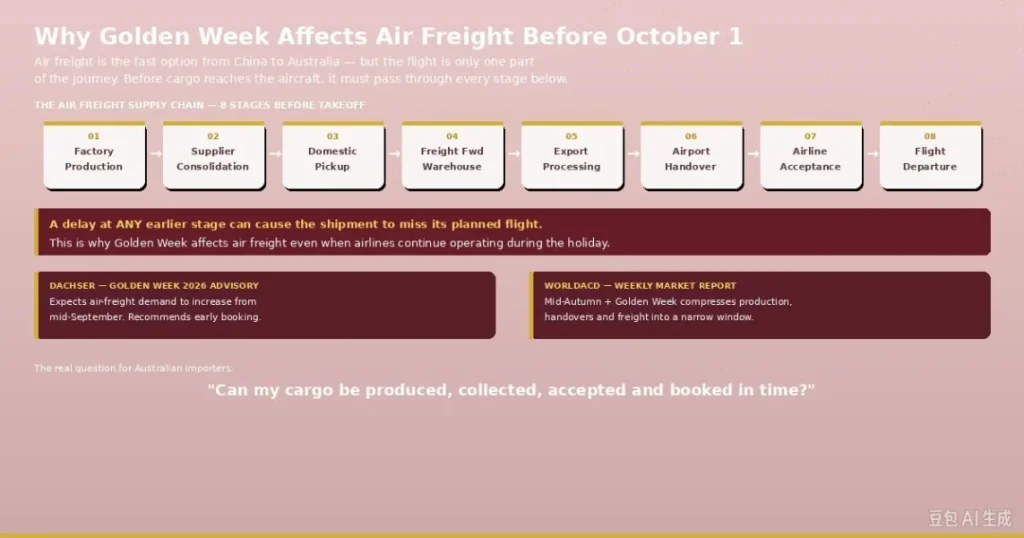
Why Golden Week Affects Air Freight Before October 1
Air freight is often considered the fast option from China to Australia. But international air transport is only one part of the shipment.
Before cargo reaches the aircraft, it may still need to go through:
Factory production → supplier consolidation → domestic pickup → freight forwarder warehouse → export processing → airport handover → airline acceptance → flight departure
A delay at any earlier stage can cause the shipment to miss its planned flight.
This is why Golden Week can affect air freight even when airlines continue operating during the holiday.
Industry advisories for Golden Week 2026 are already highlighting increased air-freight demand ahead of the holiday. DACHSER expects air-freight demand to increase from mid-September and recommends early shipment forecasting and booking. WorldACD’s latest weekly market report also says the combination of Mid-Autumn Festival and Golden Week is compressing production, export handovers and freight planning into a narrow pre-holiday window.
For Australian importers, the practical question is therefore not: “Are flights operating during Golden Week?”
It is: “Can my cargo be produced, collected, accepted and booked in time?”
Golden Week Tips for Australia Importers
China’s 2026 National Day Golden Week runs from October 1 to October 7. For importers shipping from China to Australia, however, the practical impact starts well before October 1.
The most important risk is not simply that Chinese factories close during the holiday. Production, supplier handovers, domestic trucking, warehouse receiving, export processing and air-cargo bookings can all become harder to coordinate as the holiday approaches.
This year, the timing is particularly important because China’s Mid-Autumn Festival falls on September 25–27, followed by National Day Golden Week on October 1–7. That leaves only September 28–30 as normal working days between the two holiday periods.
China Golden Week 2026: Key Dates
According to the Chinese government’s official 2026 holiday arrangement:
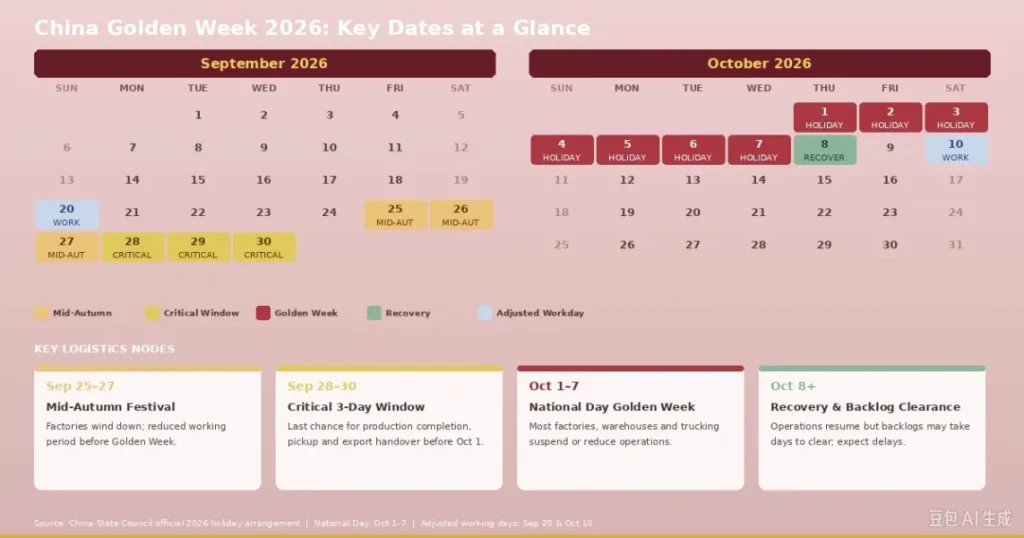
China’s State Council officially scheduled National Day holiday from October 1 to October 7, with September 20 and October 10 designated as adjusted working days.
The official public-holiday dates do not mean that every factory, warehouse, trucking company or supplier follows exactly the same schedule. Individual businesses may close earlier or reopen later. That distinction matters when planning an international shipment.
Real Case: What Happens When You Leave It Too Late
Let us return to the case from the introduction. The numbers tell the story:
| Item | Normal Scenario | Actual Outcome |
| Pickup method | SF Express (included) | Dedicated truck (extra USD 35) |
| Warehouse arrival | By 10 AM, Sep 24 | 15:45 PM, Sep 24 (late cut off) |
| Flight | Confirmed pre-holiday flight | Missed cutoff — moved to next available |
| Arrival in Australia | On schedule | 3 days late |
| Total extra cost | — | USD 35 + lost sales opportunity |
This was the Mid-Autumn Festival — a 3-day holiday. During Golden Week (7 days), the consequences multiply:
- If you miss the pre-holiday cutoff, your cargo may not move until October 8 or later.
- The post-holiday backlog means even October 8 bookings may not fly until October 8–14.
- Total delay: 8–14 days, not 3.
- For fashion, gifts, advertising materials, and fast-moving consumer goods — exactly the products our clients ship — a 8–14 day delay can mean missing a sales window entirely.
The lesson is simple: tell your forwarder about your cargo as early as possible. Even if the factory has not finished production, sharing the expected completion date and volume lets us reserve space, plan pickup, and explore alternative routings before the market tightens.
Golden Week Air Freight Tips: How to Ship Without Surprises
Based on 20 years of handling air freight from China to Australia, here is what works — and what does not.
If you have already placed orders
Share the factory completion date now.
Do not wait until the goods are ready. Even an approximate date (“around September 20”) lets us reserve capacity and plan the pickup window.
Confirm cargo dimensions and weight.
Air freight is charged on chargeable weight (actual weight vs. volumetric weight). Knowing the dimensions in advance lets us quote accurately and optimize packaging.
Prepare documents early.
Commercial invoice, packing list, and (if applicable) ChAFTA Certificate of Origin should be finalized before the cargo arrives at our warehouse. Last-minute document errors are the #1 cause of customs delays in Australia.
Consolidate multiple factories.
If you are sourcing from several suppliers, we can receive all cartons at our Guangzhou warehouse, consolidate them into one shipment, and reduce your per-shipment handling costs.
Send this information to your freight forwarder or Allwin.
- Estimated production completion date
- Number of cartons
- Estimated gross weight
- Carton dimensions, if available
- Factory pickup address
- Required delivery date in Australia
At Allwin, receiving this information early allows us to look at the shipment as a complete process rather than simply waiting for a booking request.
We can consider: Factory completion → pickup → warehouse receiving → export preparation → airline booking → flight → Australia arrival.
If the factory tells you that production will finish on September 30, for example, the logistics question is not simply whether there is a flight on October 1. The real question is whether the cargo can physically reach the warehouse and meet the relevant acceptance and airline cut-off requirements.
If You Have Not Placed the Order Yet
Work backwards from your required arrival date.
Do not calculate only: Production time + air transit time = delivery date.
A more realistic planning calculation is:
Production time + supplier coordination + pickup + warehouse handling + export processing + air-freight booking + flight/transit time + Australia-side handling + contingency
For Golden Week planning, Allwin generally recommends allowing a 2–3 week buffer before the original target date where the production schedule is still flexible.
The reason is simple: manufacturing rarely depends on one factory alone. A garment factory, for example, may still be waiting for fabric, labels, packaging, accessories, printing, embroidery or other components from upstream suppliers.
Factories are flooded with orders before Golden Week. Their production lines depend on upstream component suppliers, who are also swamped. A tight deadline increases the risk of production errors — and if errors are found too late, there is no time to correct them.
When the final deadline becomes too tight, one small delay can affect the entire shipment.
Order earlier, not faster. Rushing production leads to quality issues. Rushing shipping leads to higher rates and missed cutoffs. The cheapest option is always to build in buffer time.
If Your Cargo Is Almost Ready
Do not wait until the factory says: “Cargo is ready. Please arrange shipping today.”
Contact your forwarder immediately.
The earlier the shipment is visible, the more options there may be for:
- pickup planning
- consolidation
- flight selection
- different service levels
- partial shipment
- prioritising urgent SKUs
- comparing air and sea solutions
This is particularly important for brands with multiple suppliers.
Do not wait until the factory says: “Cargo is ready. Please arrange shipping today.”
Contact your forwarder immediately.
The earlier the shipment is visible, the more options there may be for:
- pickup planning
- consolidation
- flight selection
- different service levels
- partial shipment
- prioritising urgent SKUs
- comparing air and sea solutions
This is particularly important for brands with multiple suppliers.
The Most Overlooked Issue Behind Golden Week Shipment Delays
Golden Week problems do not always begin with an airline.
The real case above illustrates this clearly.
The important lesson is not the USD 35 emergency trucking cost. The bigger lesson is that the international flight was not the original problem.
The problem started earlier in the chain.
There was simply too little time left to recover when an unexpected operational issue occurred.
During Golden Week, this recovery window can become even narrower.Early information creates options. Late information removes them.
Looking Ahead: Chinese New Year 2027 — Start Planning Now
Golden Week is a warm-up. The real disruption is Chinese New Year (CNY), also known as the Spring Festival. In 2027, Chinese New Year falls on February 6.
Here is why CNY is far more disruptive than Golden Week:
| Factor | Golden Week (Oct) | Chinese New Year (Feb 2027) |
| Holiday duration | 7 days | 7–15 days (factories often close 3–5 weeks) |
| Worker migration | Moderate | Massive — hundreds of millions travel home |
| Factory closure | 3-7 days | 3–5 weeks, with gradual ramp-up over 1–2 weeks |
| Air freight capacity reduction | 30–40% | Up to 40–50% |
| Rate increase | 20–40% | 30–50% |
| Backlog recovery | 1–2 weeks | 2–3 weeks |
| Recommended booking lead time | 2–3 weeks | 4–6 weeks |
(Source: SINO Shipping; SEKO Logistics Lunar New Year 2027 Planning Guide; China Fulfillment CNY 2027 Deadlines)
Importers should not rely on an unofficial “factory closure date” published online as if it were an official nationwide schedule.
Instead, confirm the following directly with each supplier:
- Last production date
- Last date for receiving materials
- Last domestic pickup date
- Factory shutdown date
- Expected reopening date
- First production date after the holiday
- Expected backlog after reopening
For businesses with February or March sales commitments, this conversation should begin well before the holiday.
Your CNY 2027 Air Freight Planning Timeline
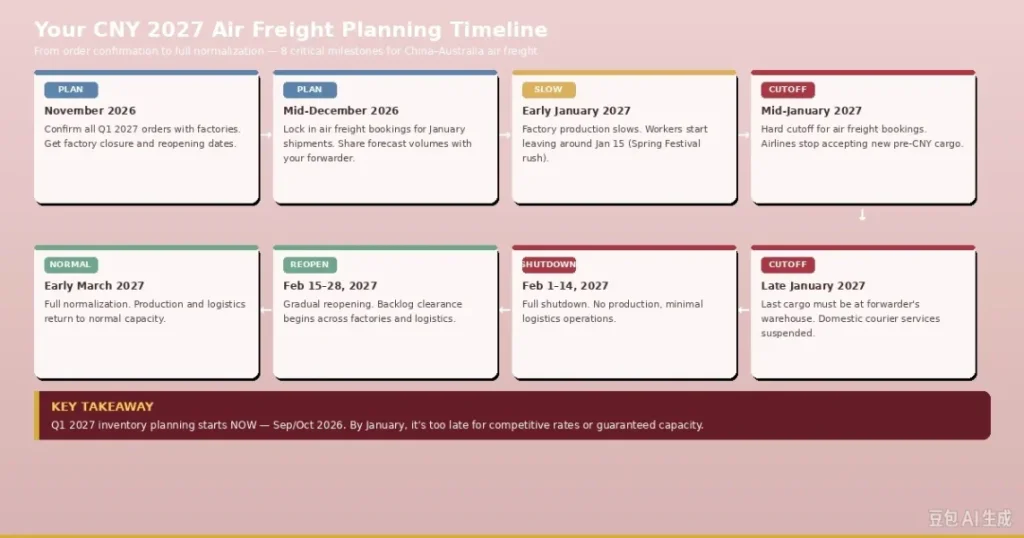
Key takeaway: If you have Q1 2027 inventory needs, the planning starts now — in September/October 2026. By January, it is too late to lock in competitive rates or guaranteed capacity.
Golden Week & New Year Shipping Checklist
☐ Factory completion date
☐ Number of cartons
☐ Estimated gross weight
☐ Carton dimensions
☐ Pickup address
☐ Cargo-ready date
☐ Required Australia delivery date
☐ Air-freight service options
☐ Airline/forwarder booking deadline
☐ Export documentation
☐ Australia customs requirements
☐ Backup plan if the original flight is missed
If you have several suppliers, create one consolidated shipment plan instead of treating every factory as a separate emergency.
How Allwin Helps You Plan Golden Week
For many small Australian brands, the difficult part of China sourcing is not placing the order. It is coordinating several suppliers, production schedules and shipping deadlines at the same time.
This is where an experienced China-side logistics partner can become useful.
If you provide:
- supplier information
- expected factory completion dates
- shipment volume
- required delivery date
Allwin can help coordinate the logistics side before the cargo is ready.
This may include following up with suppliers, monitoring production timing, arranging pickup, checking shipment options and planning air-freight space.
The earlier we know about the shipment, the more opportunity there is to compare solutions rather than simply reacting to an emergency.
For an Australian importer without a large logistics team in China, this can effectively provide an extra pair of hands on the China side.
Frequently Asked Questions
When is China Golden Week 2026?
China’s National Day Golden Week is the October 1–7 holiday period in 2026. For logistics, its impact can begin before the official holiday because factories, suppliers and shippers may accelerate production and shipments ahead of closures.
What is the latest cutoff for air freight before Golden Week?
For the 2026 Golden Week (October 1–7), cargo should be at your forwarder’s warehouse by September 29–30. Airlines typically stop accepting new bookings 3 days before the holiday. After that, you are on standby — and standby space is not guaranteed.
Does air freight operate during Golden Week?
Air services can continue operating during the holiday, but that does not mean every part of the supply chain operates normally. Factory production, domestic pickup, warehouse receiving and export handling can be affected.
When should I book air freight before Golden Week?
There is no single booking deadline for every China–Australia shipment. The appropriate lead time depends on the origin, destination, cargo size, service and required departure date. For time-sensitive shipments, early planning is preferable to waiting until the cargo is ready.
Can my factory ship immediately before Golden Week?
Possibly, but the factory completion date alone does not guarantee shipment. Pickup availability, warehouse receiving, documentation, airline acceptance and flight capacity also need to be considered.
What happens if I miss my planned air-freight cut-off?
Your forwarder may need to look for the next available flight or another routing. The resulting delivery date and cost will depend on the specific shipment and available capacity.
Is Golden Week worse than Chinese New Year for shipping?
The two holidays have different operational patterns. Golden Week is a shorter National Day holiday, while Chinese New Year can involve a much broader production and workforce disruption. For either period, supplier-specific production schedules are more useful than relying only on generic holiday dates.
Is air freight safer than sea freight before Chinese New Year?
Air freight is faster, but it is not necessarily “safer” during CNY. Both modes face severe capacity constraints before CNY. Air freight has a later cutoff (1–2 weeks before) compared to sea freight (3–4 weeks before), but air rates are more volatile and space disappears quickly. For high-value, time-sensitive goods, air freight is the better choice — but only if booked early.
When should I start planning for Chinese New Year 2027?
Chinese New Year falls on February 6, 2027. If your products have long production cycles or strict Australian sales deadlines, start discussing production and logistics plans with suppliers during Q4 2026 rather than waiting until January.
How early should I place factory orders before CNY 2027?
For air freight shipments before CNY 2027 (February 6), factory orders should be placed by mid-November 2026 at the latest. This allows 6–8 weeks for production, considering pre-holiday factory congestion and upstream component delays. If you wait until December, you risk production not being completed before the factory shutdown.
What documents do I need for air freight during Golden Week?
The same documents as always — commercial invoice, packing list, and air waybill — but they must be finalized earlier. If your goods qualify for ChAFTA preferential duty (0% for most manufactured goods from China), ensure the Certificate of Origin is applied for before the flight departs. A scanned copy is sufficient for Australian customs clearance.
Final Takeaway: Plan Ahead, Ship on Time
Golden Week and Chinese New Year are predictable disruptions. They happen at the same time every year.
Golden Week does not suddenly make international air freight stop on October 1.
The bigger risk is allowing a shipment to become urgent at the same time that factories, trucking companies, warehouses and logistics providers are operating under tighter schedules.
The importers who avoid delays and premium rates are the ones who plan ahead — not the ones who call at 4 PM the day before the cutoff.
At Allwin Logistic, we act as your team on the ground in China. We do not just move cargo — we coordinate with your factories, reserve capacity before the market tightens, consolidate multiple suppliers into one shipment, and pre-audit all documents to ensure zero-delay customs clearance in Australia.
If you have air freight shipments planned for October 2026 or Q1 2027, tell us now. Share your factory completion dates, expected volumes, and target arrival dates. We will build a shipping plan that locks in capacity, optimizes costs, and ensures your cargo arrives when you need it.
Contact Allwin Logistic today for a free pre-holiday shipping assessment.
The earlier we know about your shipment, the more options we have to help you move it.
Sources & Methodology
- China State Council / official 2026 holiday arrangement: National Day October 1–7, 2026; adjusted working days September 20 and October 10.
- DACHSER China Golden Week 2026 advisory: increased air-freight demand expected from mid-September; early forecasting and booking recommended.
- WorldACD weekly air-cargo market reporting: recent Asia-Pacific demand/rate movement and the impact of the compressed holiday period.
- Flexport Global Logistics Update, September 24, 2026: increased North China general-cargo demand ahead of Golden Week and additional charter capacity.
- Allwin first-hand operational experience: September shipment example involving late notice, emergency trucking and a missed cut-off.
- SEKO Logistics — “China Golden Week 2026: Complete Supply Chain Disruption Guide” (August 2026)
- SINO Shipping — “Delays from Golden Week and Chinese New Year in Air Freight from China” (2026)
- KAK Sourcing — “China Shipping Calendar 2026: Chinese New Year, Holidays & Lead Time Impact” (September 2026)
- Forto — “Golden Week in China and Its Impact on Supply Chains” (September 2026)
- iContainers — “China Golden Week 2026: Possible Effects on Shipping and How to Prepare” (August 2026)
- SEKO Logistics — “Lunar New Year 2027: Complete Supply Chain Planning Guide” (August 2026)
- China Fulfillment — “Chinese New Year 2027 Shipping Deadlines” (August 2026)
- ICAT Logistics — “Golden Week in China: How to Prepare Your Supply Chain” (2026)
Market indicators are not individual freight quotations. Final rates, schedules and cut-offs depend on the specific shipment and current operational conditions.