
Air Freight Rates Increased – Shipping Trends From China To Australia – Week 38 Update
Written by Leon Chow
China–Australia Freight Forwarding Specialist | Guangzhou Allwin Logistic
China to Australia Freight Market Overview
Week 38 | 21–27 September 2026
Overall Market Status: 🟠 Elevated Disruption
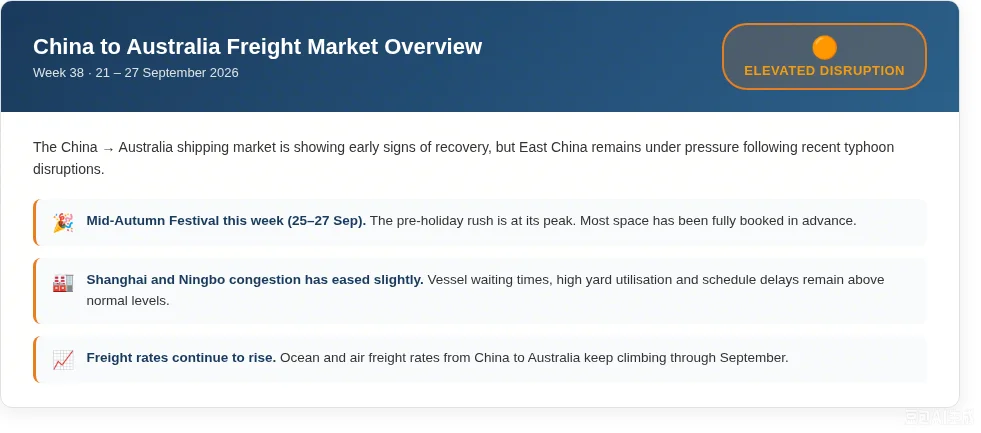
Mid-Autumn Festival falls this week (25–27 Sep). The pre-holiday rush is at its peak. Most of the space have been fully booked in advance.
The China → Australia shipping market is showing early signs of recovery, but East China remains under pressure following the recent typhoon disruptions.
Shanghai and Ningbo congestion has eased slightly, but vessel waiting times, high yard utilisation and schedule delays remain above normal levels.
At the same time, freight rates from China to Australia continue to increase.
Current Air Freight Rates to Australia
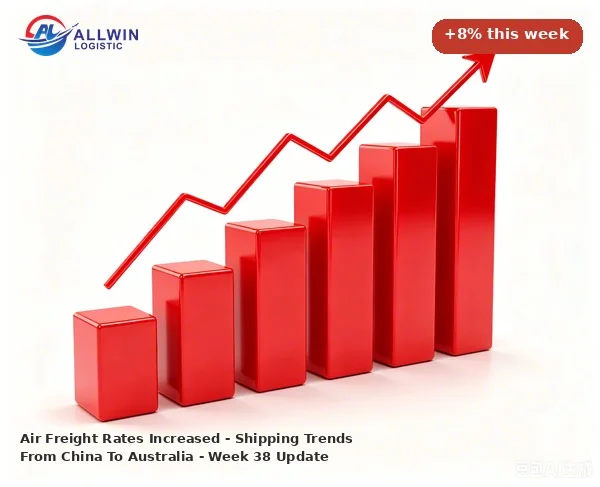
Air freight rates to Australia rose again this week. Air freight rates have increased by approximately 8% compared to last week. Based on our booking data from Guangzhou and Shenzhen to Sydney, Melbourne and Brisbane.
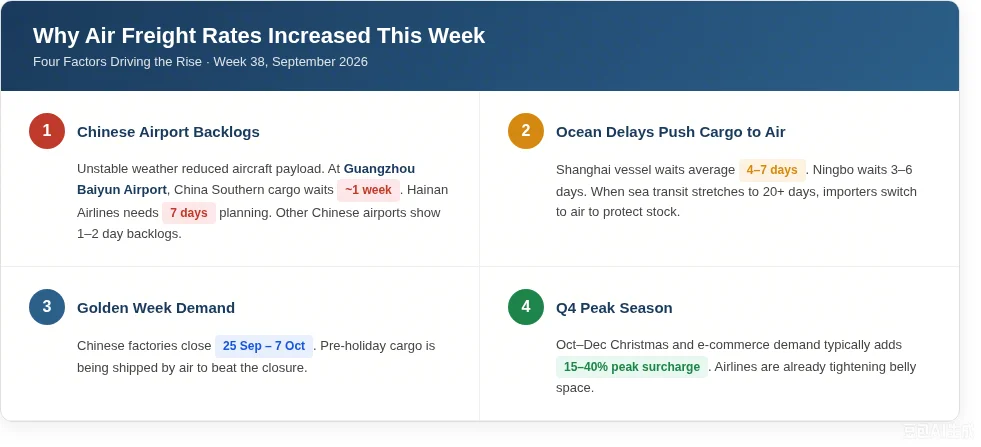
Why Air Freight Rates Increased This Week
Air freight rates to Australia have increased for four reasons:
1. Chinese airport backlogs.
Unstable weather reduced aircraft payload. At Guangzhou Baiyun Airport, China Southern cargo waits about one week. Hainan Airlines needs seven days planning. Other Chinese airports show 1-2 day backlogs (Allwin operational data, Week 38).
2. Ocean delays push cargo to air.
Shanghai vessel waits average 4-7 days. Ningbo waits 3-6 days. When sea transit stretches to 20+ days, importers switch to air to protect stock.
3. Golden Week demand.
The Mid-Autumn Festival holiday runs from September 25 to September 27.
The National Day holiday runs from October 1 to October 7.
These holidays affect factories, shipping companies, and customs operations; consequently, there is a push to ship goods out before the break begins.
October shipments are approaching China’s National Day and Golden Week period. Capacity planning becomes increasingly important as carriers adjust schedules around the holiday period.
4. Q4 peak season.
October-December Christmas and e-commerce demand typically adds 15-40% peak surcharge. Airlines are already tightening belly space.
For urgent cargo, we recommend requesting an international air freight quote before production is completed. Accurate carton dimensions, gross weight and cargo-ready date allow the forwarder to compare airline capacity and routing options.
Sea Freight Rates and Schedule
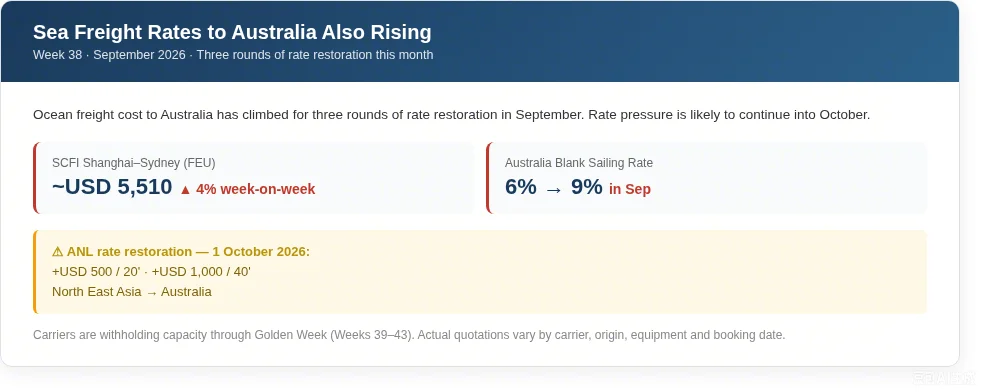
Sea Freight Rates to Australia Also Rising
Ocean freight cost to Australia has climbed for three rounds of rate restoration in September.
The Week 38 Shanghai–Sydney SCFI benchmark reached approximately USD 5,510 per FEU, an increase of 4% from Week 37. Week 37 had already increased by around 7%, indicating continued rate pressure on the trade.
Carrier actions also support this trend. MSC introduced a USD 500/TEU Service Disruption Surcharge from 15 September for certain long-term cargo moving from China and other Asian origins to Australia. ANL has separately announced a USD 500/20′ and USD 1,000/40′ rate restoration for North East Asia → Australia shipments from 1 October.
These measures do not mean every shipment will increase by the same percentage. Actual quotations depend on carrier, origin, destination, equipment, contract terms and booking date.
The blank sailing rate on Australia trades rose from 6% to 9% in September. Carriers are withholding capacity through Golden Week (Weeks 39-43).
This indicates that rate pressure is likely to continue into October, although actual quotations will vary by carrier, origin, equipment and booking date.
Our recommendation: confirm October bookings early and compare alternative carriers or origin ports where practical.
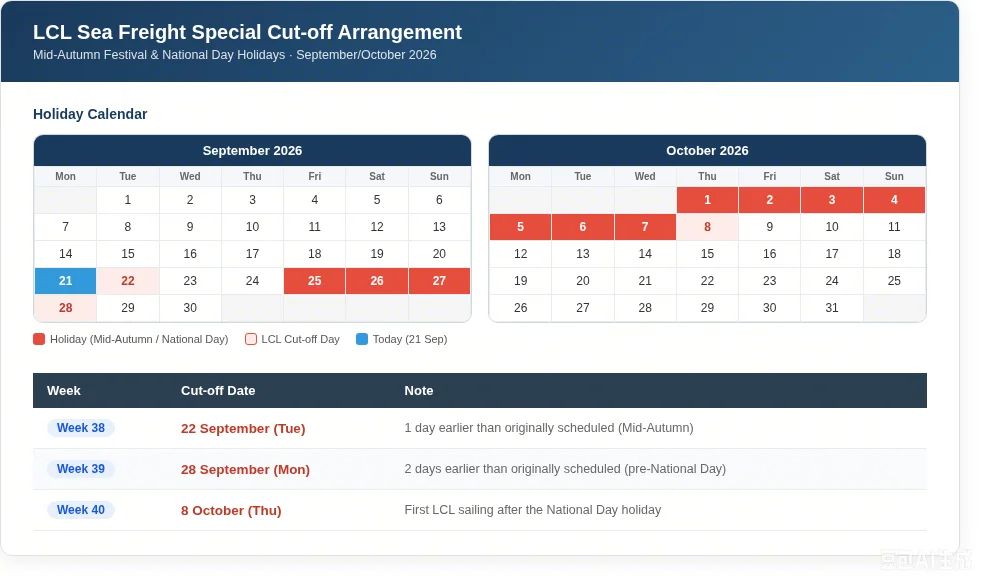
LCL Sea Freight Special Schedule Arrangement
Mid-Autumn Festival & National Day Holidays
Week Cut-off Date
38 Sep 22 (1 day earlier than originally scheduled)
39 Sep 28 (2 days earlier than originally scheduled)
40 Oct 8 (First sailing after the National Day holiday)
Vessel/Flight Schedule & Capacity
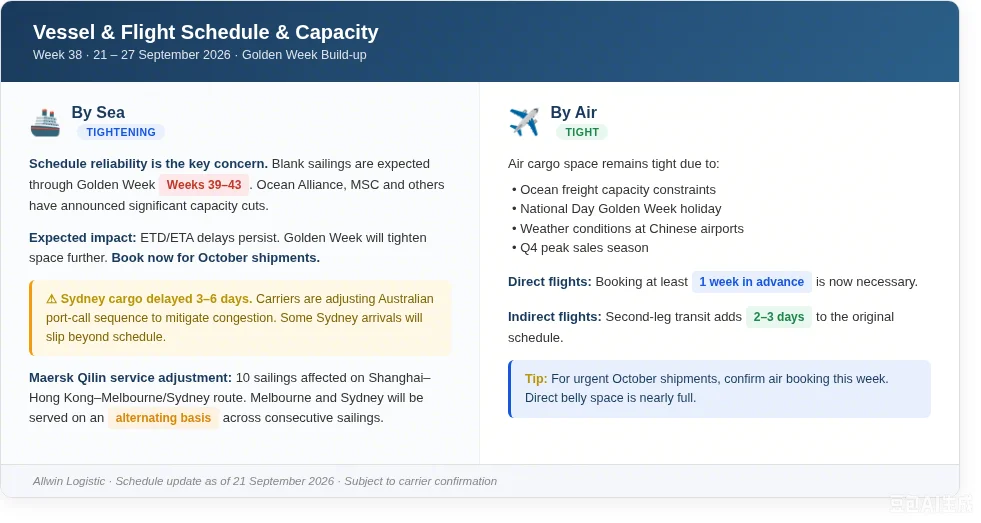
By Sea: Schedule reliability remains the key concern.
Blank sailings are expected through Golden Week (Weeks 39–43). Ocean Alliance, MSC and others have announced significant capacity cuts.
MSC has introduced a USD 500/TEU Service Disruption Surcharge for certain long-term cargo moving from China and other Asian origins to Australia, effective 15 September.
For shipments with firm delivery deadlines, we recommend checking the latest vessel schedule and revised ETA before dispatch.
Expected impact: ETD/ETA delays persist. Golden Week will tighten space further. Book now for October shipments.
Additionally, due to factors such as severe schedule delays and port congestion, some shipping lines are adjusting the sequence of port calls in Australia to mitigate delays.
Consequently, the arrival of some cargo destined for Sydney will be delayed by at least 3–6 days beyond the original schedule.
Meanwhile, Maersk has announced a temporary adjustment to its Qilin service (Shanghai – Hong Kong – Melbourne / Sydney) covering 10 sailings. Instead of calling at both Australian ports on every voyage, Melbourne and Sydney will be served on an alternating basis across consecutive sailings.
By Air: Due to factors such as ocean freight capacity constraints, the National Day Golden Week holiday, weather conditions, and the peak sales season, air cargo space remains tight.
Direct flights: Booking and scheduling at least one week in advance are expected to be necessary.
Indirect flights: Transit times for the second leg of the flight are expected to add 2–3 days to the original schedule.
Port & Schedule Update
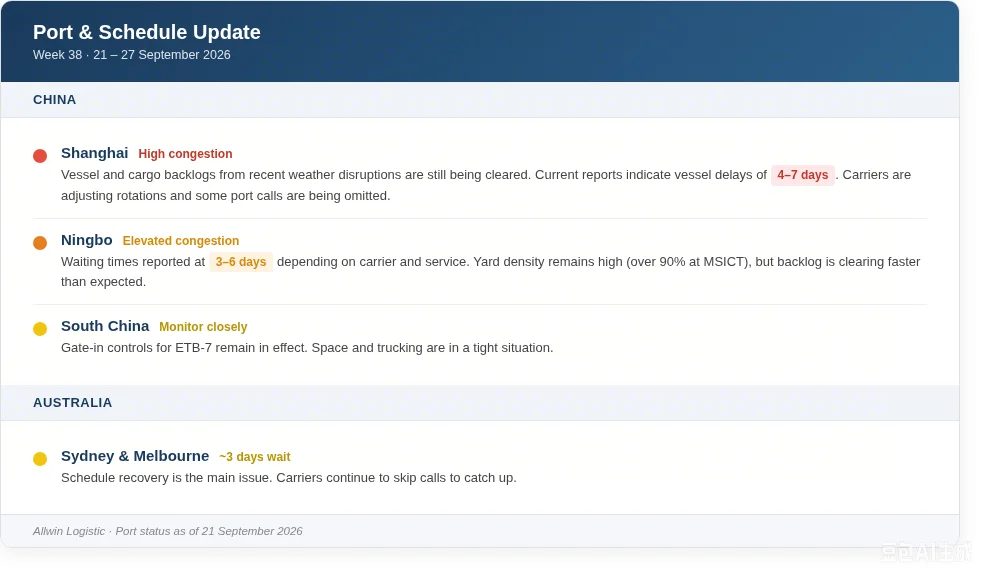
China
Shanghai — High congestion
Kuehne+Nagel’s latest operational update for 9–15 September reports a 7-day average vessel waiting time of 4.42 days. Waiting times at some Yangshan and Waigaoqiao terminals remain between 7 and 8 days, while yard occupancy is still high.
Conditions are expected to stabilise with some improvement from Week 38, but Shanghai remains above Kuehne+Nagel’s 4-day threshold for a heavily disrupted port.
- Vessel and cargo backlogs from recent weather disruptions are still being cleared.
- Current reports indicate vessel delays of 4-7 days.
- Carriers are adjusting rotations and some port calls are being omitted.
Ningbo — Elevated congestion
The latest 7-day average vessel waiting time is approximately 3.19 days, down from 3.58 days in the previous reporting period. However, yard density remains high, and MSICT is still reporting waiting times of around 5 days.
- Current waiting times are reported at 3–6 days depending on carrier and service.
- Yard density remains high (over 90% at MSICT), but backlog is clearing faster than expected .
South China — Monitor closely
- Gate-in controls for ETB-7 remain in effect, space and trucking is in tight situation.
Australia
- Sydney and Melbourne remain ~3 days.
- Schedule recovery is the main issue. Carriers continue to skip calls to catch up.
Schedule Reliability
Although the immediate weather disruption has eased, carriers are still working through accumulated delays.
This can lead to:
- revised ETD and ETA;
- vessel bunching;
- port rotation changes;
- rolled cargo;
- equipment imbalances; and
- tighter booking windows.
For time-sensitive cargo, the original booking schedule should therefore be treated as a planning reference rather than a guaranteed arrival date.
Weather Alert
No active typhoon threatens Chinese ports. Typhoon Dujuan (2625) is tracking near Japan. Saudel and Krovanh have dissipated.
The main risk is no longer weather. It is the accumulated backlog and the Golden Week rush.
Our Recommendation for Week 38
For importers shipping from China to Australia, we recommend:
1. Book October shipments early.
Do not wait until cargo is factory-ready if the delivery deadline is fixed.
Book air at least one week ahead. Direct flights are nearly full.
2. Add a schedule buffer.
Shanghai and Ningbo are improving, but delays have not completely disappeared.
Add 7-10 days to any ocean ETA. Global schedule reliability is 56.4%.
3. Compare more than one routing.
Alternative China gateways and carrier services may provide better space or schedule reliability.
4. Consider air freight for urgent cargo.
When the cost of missing a launch, promotion or retail deadline is high, air freight can provide a faster alternative to ocean shipping.
5. Confirm BMSB requirements before dispatch.
Correct treatment and documentation can help avoid unnecessary Australian biosecurity delays.
Frequently Asked Questions
Is shipping from China to Australia improving in Week 38?
Conditions are improving gradually, particularly at Ningbo. However, Shanghai remains congested, with a 7-day average vessel waiting time of around 4.42 days and some terminals still reporting 7–8 day waits.
Is the sea freight cost to Australia increasing?
Current evidence shows continued upward pressure on the China–Australia trade. The Week 38 Shanghai–Sydney SCFI benchmark increased 4% week on week to around USD 5,510/FEU, while carriers have announced additional rate measures.
Should I use air freight from China to Australia?
Air freight is worth considering when delivery speed is more important than the lowest transport cost. It can also bypass ocean-port congestion.
How early should I book China–Australia freight?
For shipments with fixed deadlines, earlier booking is recommended while carriers continue recovering schedules and October capacity planning begins.
How much are air freight rates to Australia right now?
It depends on the lead time you need to meet your delivery deadline. Generally, air freight rates rose 8% week-on-week.
Why did air freight rates increase to Australia?
Four reasons: Chinese airport backlogs, ocean delays diverting cargo to air, Golden Week pre-holiday demand, and Q4 peak season. Air freight rates from China to Australia typically rise in September-October.
Will air freight rates to Australia go down in October?
Rates may soften briefly after Golden Week (after 7 October), but Q4 Christmas demand will push them up again from November. Book urgent cargo in advance.
How do I get an international air freight quote?
Send your cargo weight, volume, origin and destination. We compare direct and indirect carriers and return a same-day quote for air freight from China to Australia.
About This Weekly Update
This report is prepared by Allwin Logistic, a China–Australia freight forwarding company, based on carrier announcements, port operational data, published freight-market information and our practical experience handling China-origin shipments.
Market conditions can change quickly. Freight rates, vessel schedules and available capacity may vary by origin, destination, cargo type, carrier and booking date. Published rate figures should therefore be treated as market references rather than guaranteed quotations.
For a complete overview of historical market movements, visit our China to Australia Shipping Trends Hub.
Last updated: 21 September 2026