
Air Freight Rate Surge – Shipping Trends From China To Australia – Week 37 Update
Written by Leon Chow
China–Australia Freight Forwarding Specialist | Guangzhou Allwin Logistic
China to Australia Freight Market Overview
Week 37 | 14 September – 20 September 2026
Overall Market Status: 🟠 Elevated Disruption
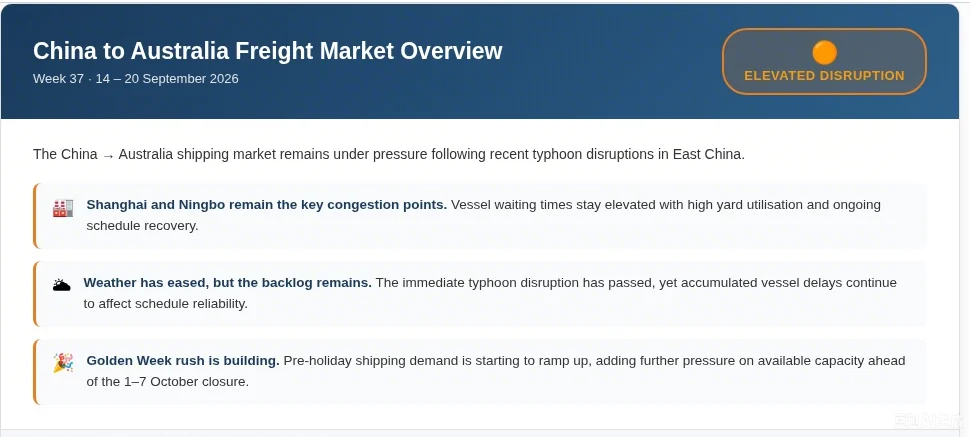
The China → Australia shipping market remains under pressure following the recent typhoon disruptions in East China.
Shanghai and Ningbo remain the key congestion points, with vessel waiting times still elevated, high yard utilisation and ongoing schedule recovery.
The immediate weather disruption has eased, but the accumulated vessel backlog continues to affect schedule reliability.
The pre–Golden Week shipping rush is also beginning to build, adding further pressure on available capacity.
Sea & Air Freight Rate Trends
Sea Freight Cost to Australia Rising
Ocean freight cost to Australia has climbed sharply in 2026. The SCFI Australia/New Zealand index reached USD 2,640/TEU in early September, up 6.84% week-on-week (Shanghai Shipping Exchange, 4 Sep 2026). Spot rates for a 40HQ to Sydney, Melbourne, or Brisbane now average around USD 5,200.
Three forces are driving this.
First, 4.3 million TEU of container ships are waiting at anchor globally—12.4% of the world fleet and above the 2022 COVID peak (Linerlytica, September 2026). Shanghai and Ningbo account for the worst backlogs.
Second, carriers are cutting capacity: ANL has announced another USD 500 per 20ft and USD 1,000 per 40ft rate restoration effective 1 October (ANL official advisory, 2 September 2026). MSC and COSCO imposed similar USD 500/TEU GRIs in August.
Third, bunker fuel costs—Singapore VLSFO at USD 856 per tonne, up 76% since the Iran conflict escalated (ZeroNorth, September 2026)—are being passed through to shippers.
What comes next? Most analysts expect rates to stay firm through October. The pre-Golden Week rush (Mid-Autumn 25–27 Sep, National Day 1–7 Oct) and Q4 Christmas restocking are pulling demand forward. Carriers are blanking sailings in Weeks 39–43 to defend rates. A modest pullback may appear after the holiday, but November restocking should push rates higher again.
Our advice: book September–October shipments earlier, compare multiple carriers and origin ports, and consider flexible routing where practical.
For urgent or smaller shipments, air freight can also provide a useful alternative when ocean schedules become unreliable.
Air Freight Rate Surge to Australia
Currently, air freight rates from China to Australia remain relatively firm; major carriers such as China Southern Airlines and Hainan Airlines have raised their rates by 10%–15% compared to last week.
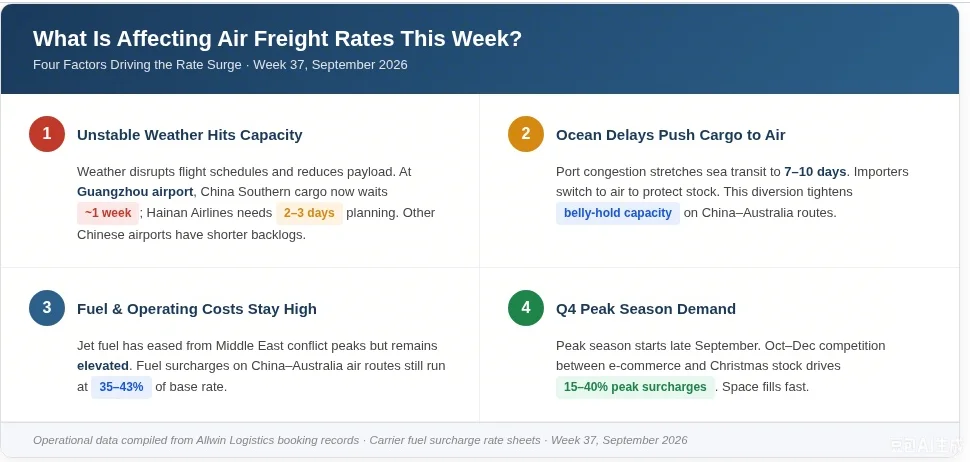
What Is Affecting Air Freight Rates Surge This Week?
Four factors are driving this price increase:
Unstable Weather Impact Capacity
Based on our latest operational experience, unstable weather has impacted flight scheduling and cargo capacity, while a buildup of shipments has created booking backlogs. At Guangzhou Airport, our latest booking data for China Southern indicates cargo waiting times of approximately one week in advanced, while shipments via Hainan Airlines currently require about 2-3 days planning in some instances. Other Chinese gateway airports are also experiencing backlogs, albeit of shorter duration.
Delays In Ocean Freight Driving Shipping The Goods By Air
Delays in ocean freight are driving a shift toward air freight. When port congestion extends ocean transit times to 7–10 days, importers often switch to air freight to ensure sufficient stock levels; this shift tightens belly-hold capacity on the China-Australia route.
Fuel And Operating Costs
Fuel surcharges remain high. Although aviation fuel prices have retreated from the peaks caused by Middle East conflicts, they remain at elevated levels.
Market Demand
The fourth-quarter peak season is set to begin in late September. During the October–December period, competition for cargo space between e-commerce goods and Christmas inventory typically results in peak season surcharges ranging from 15% to 40%.
When Air Freight Services Make More Sense Than Sea Freight
Air freight services can make sense when the cargo is urgent, high-value, light, seasonal or needed to prevent a stockout.
Sea freight remains better for many large and less time-sensitive shipments.
The best decision is often a comparison rather than a single mode.
For example: bulk inventory by sea, urgent replenishment by air.
Ocean Freight Pressure Is Increasing the Value of Air Freight
Air freight is not always cheaper than sea freight. It is usually more expensive per kilogram.
The decision changes when inventory delay has a commercial cost.
For example, one of our fashion brand client S Active in Australia, today with a new collection—a shipment weighing 1,100 kg—that needed to reach the market urgently.
However, shipping the entire consignment by air would have been prohibitively expensive, likely wiping out all the profit.
Thanks to our close communication with airlines and shipping lines, by comparing rates and transit times across various service channels, we devised an optimal solution:
shipping the 25% of SKUs with the highest urgency by air, while sending the rest by sea.
This approach can protect product launch dates while controlling the total logistics budget.
Space & Capacity: Vessel & Flight Schedules
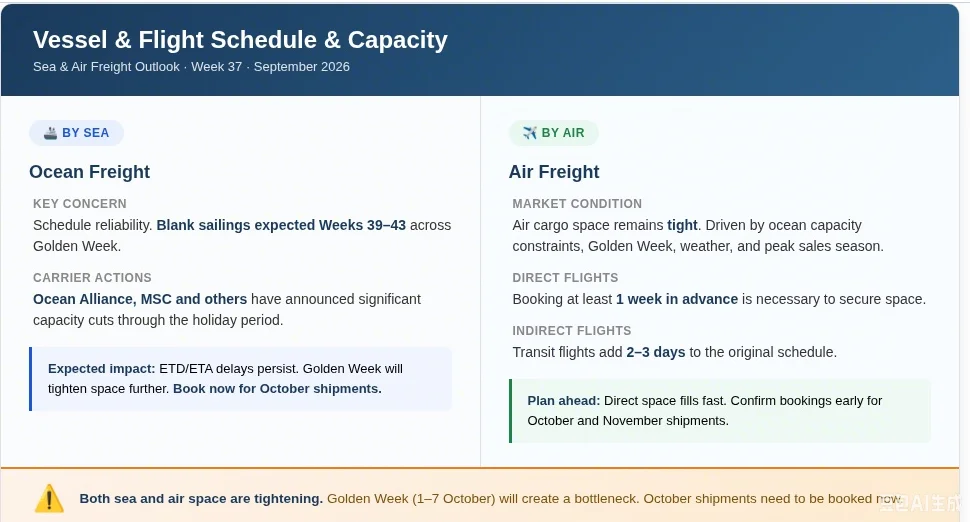
By Sea: Schedule reliability remains the key concern.
Blank sailings are expected through Golden Week (Weeks 39–43). Ocean Alliance, MSC and others have announced significant capacity cuts.
Expected impact: ETD/ETA delays persist. Golden Week will tighten space further. Book now for October shipments.
By Air: air cargo space remains tight.
Due to factors such as ocean freight capacity constraints, the National Day Golden Week holiday, weather conditions, and the peak sales season, air flight space remains very tight.
Direct flights: Booking and scheduling at least one week in advance are expected to be necessary.
Indirect flights: Transit times for the second leg of the flight are expected to add 2–3 days to the original schedule.
China and Australian Port Conditions & Customs Updates
China Port Remain Serious Congestion
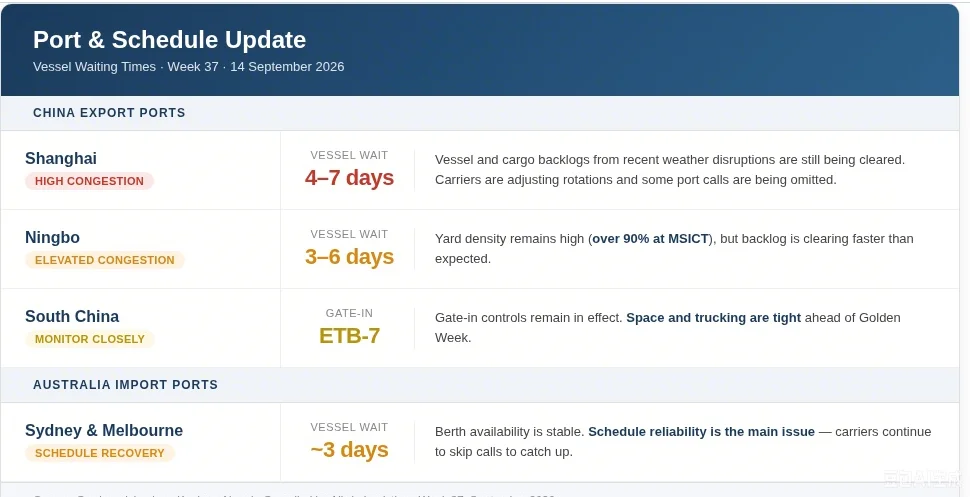
Shanghai — High congestion
Vessel and cargo backlogs from recent weather disruptions are still being cleared.
Current reports indicate vessel delays of 4-7 days.
Carriers are adjusting rotations and some port calls are being omitted.
Ningbo — Elevated congestion
Current waiting times are reported at 3–6 days depending on carrier and service.
Yard density remains high (over 90% at MSICT), but backlog is clearing faster than expected.
South China — Monitor closely
Gate-in controls for ETB-7 remain in effect, space and trucking is in tight situation.
Australia, Sydney port congestion, Vessels Rerouting to Melbourne
Sydney — High congestion
Sydney berth congestion is now forcing carriers to reroute vessels.
On 1 September 2026, ANL announced that COSCO ROTTERDAM 213N would change its rotation and call Melbourne before Sydney to reduce downtime on the Australian coast (ANL official advisory, 1 September 2026). The vessel did not skip Sydney entirely—it went to Melbourne first, then returned.
This is not an isolated case. In September alone, at least six vessels on China–Australia services have adjusted or omitted their Sydney call. CMA CGM’s NORDPACIFIC 6533/6433 omitted Sydney entirely as a schedule recovery measure (CMA CGM advisory, 2 September). Maersk’s OLUF MAERSK 632S also skipped Sydney on 3 September. The pattern is clear: carriers prefer to redirect vessels to Melbourne rather than wait for a Sydney berth.
What it means for shippers: Expect ETA Sydney to shift by 3–7 days even when the vessel is not blanked. Always confirm the revised rotation before assuming your cargo will discharge on schedule.
Melbourne — High congestion
Remain 1-3 days waiting time. Schedule recovery is the main issue.
Customs Updates
Both Chinese and Australian customs have stepped up container inspections following a major joint anti-smuggling operation.
In August 2026, the Australian Border Force (ABF) and China Customs dismantled an illicit tobacco ring linked to Top Logistics Australia. The operation—Project SEAHORSE—seized 91 containers of smuggled tobacco worth AUD 92 million and led to 60+ arrests in China (ABF official announcement, 20 August 2026).
Since then, Australia has raised inspection rates on all China–Australia cargo. X-ray screening now covers over 80% of containers, with high-risk categories subject to 100% manual inspection. Even compliant shipments face longer clearance cycles. Expect 1–3 extra days of customs delay on top of normal port waiting time.
Seasonal Weather & Operation Risks
Both Typhoon Saudel and Tropical Storm Krovanh have dissipated. No active tropical cyclones are currently tracked. Meteorological conditions are calm across the East and South China Seas.
The main risk is no longer weather. It is the accumulated backlog and the Golden Week rush.
Our Recommendation for Week 37
For Australian importers, the most practical strategy this week is to separate cargo by urgency.
- Urgent stock: compare air freight from China with the cost of delayed inventory.
- Standard stock: keep sea freight as the lower-cost option when timing allows.
- Shanghai/Ningbo cargo: add schedule buffer and monitor the vessel after booking.
- Pre-Christmas inventory: confirm space earlier rather than waiting for the final sailing.
- Air quotes: provide final dimensions and weight to avoid an inaccurate budget.
At Allwin Logistics, we can compare air freight, sea freight and hybrid options based on cargo urgency, dimensions, destination and budget. Our objective is not simply to find the lowest rate. It is to find a workable balance between cost, speed and reliability.
Frequently Asked Questions
What is the air freight rate to Australia from China?
There is no universal rate. Recent public September references show roughly USD 4–6/kg for some 1,000 kg China–Sydney examples, while other market guides publish lower or higher figures. Your final rate depends on origin, destination, chargeable weight, airline, service and surcharges.
Why can two air freight quotes differ?
Different forwarders may use different airlines, consolidations, weight breaks, surcharges and delivery scopes. The quote may also use a different chargeable weight.
How fast is air freight from China to Australia?
Public route references commonly show about 3–7 days for standard air-freight services, but total door-to-door time depends on pickup, export handling, flight connection, customs and delivery.
What information is needed for an international air freight quote?
Provide origin, destination, commodity, carton count, final dimensions, gross weight, cargo-ready date and required delivery date. If possible, also provide the HS code and whether the cargo is dangerous or temperature-sensitive.
Should I use air freight when China ports are congested?
It can be a good option for urgent cargo. Port congestion mainly affects ocean freight, so air can bypass many ocean-port delays. The right choice depends on the commercial cost of delay versus the additional air-freight cost.
For a complete overview of historical market movements, visit our China to Australia Shipping Trends Hub.